
Cleaner Air on the Industrial Highway: No PUCC No Fuel Supports the Zones
Third plant (~JPY 10bn) tracks to Sep 2026 completion.
Read the full story
Cleaner Air on the Industrial Highway: No PUCC No Fuel Supports the Zones
Third plant (~JPY 10bn) tracks to Sep 2026 completion.
Read the full storyThe No PUCC No Fuel campaign in Behror-Neemrana has already challaned hundreds of vehicles without valid pollution certificates. Petrol pumps now refuse fuel to non-compliant vehicles. Transport department and traffic police teams have issued more than four hundred challans in recent weeks as the drive continues across the NCR stretch of the corridor.
The enforcement supports the Japanese and Indian plants that already run cleaner processes inside their boundaries. Many of these units maintain careful emission controls, regular equipment upkeep and disciplined vehicle practices within their premises. Extending the same standard to the public highway reduces the dust and exhaust that reach factory gates and worker housing. Factory fleets and supplier trucks can lead compliance by keeping every company vehicle and vendor lorry on a current PUCC, setting a clear example for the broader traffic that moves goods and people along NH-48.
The Zone Fleet Clean-Air Compact turns that leadership into a simple shared practice. Plants and their regular transporters agree to maintain valid certificates for all vehicles that enter the zones, share compliance status at vendor meetings, and coordinate with local pumps so that fuel access remains smooth for compliant fleets. The compact adds no new institution; it simply aligns existing plant discipline with the ongoing public campaign.
To Japanese and Indian manufacturers already invested on the highway, the drive is a practical environmental step that matches their own cleaner operations. It improves the daily air quality around the industrial edge, supports the greener approach marked by Environment Marg, and reinforces Neemrana as a corridor where manufacturing growth and cleaner mobility advance together.

Japanese Workplace Culture Reaches Neemrana ITI Classrooms
Read the full story
Japanese Workplace Culture Reaches Neemrana ITI Classrooms
Read the full storyWith Neemrana ITI now a PM-SETU spoke in the ₹241-crore Bhiwadi cluster, a short module on 5S, visual management and basic Japanese shop-floor terms can work alongside the new EV and robotics courses. The addition gives local students both the technical skills the upgraded laboratories will teach and the cultural fluency Japanese lines value on the shop floor.
5S-sort, set in order, shine, standardise, sustain-and visual management are everyday practices inside Japanese Zone plants. Basic terms for tools, quality checks and safety become familiar language rather than foreign vocabulary. A compact Japan Classroom Pilot can deliver these elements in a few weeks, using the same campus model already proven at the Daikin Japanese Institute of Manufacturing Excellence nearby. Students leave with certificates in emerging trades and a practical grasp of the workplace habits that Japanese manufacturers look for when they hire.
A trainee who has practised 5S and heard shop-floor Japanese can step more confidently into an apprenticeship at a plant a short drive away. Japanese companies gain technicians who understand both the machines and the culture of continuous improvement. Indian manufacturers benefit from the same disciplined habits. The pilot turns the ITI’s new role as a spoke into a living culture-skills bridge that strengthens the talent pipeline the corridor is building.

Mirai Hills Meets the Japanese Preference for Clean, Efficient Living Beside the Zone
Read the full story
Mirai Hills Meets the Japanese Preference for Clean, Efficient Living Beside the Zone
Read the full storyJapanese professionals posted to industrial sites look for residences that are clean, orderly and free of unnecessary complication. They prefer compact LDK layouts where living, dining and kitchen share one well-lit space, good natural light and ventilation, reliable water and power, and quiet surroundings that support family life. Managed services matter because they allow focus on work rather than daily maintenance. Proximity to the plant is valued so that the daily journey stays short and predictable.
Briston presents Mirai Hills on NH-48 beside the Japanese Zone with Japanese-style LDK layouts and managed-residence services. Company describes the project as shaped for managers, engineers and families who need longer stays inside Neemrana. The design is efficient, uncluttered living spaces on the same highway as the factories, with services that handle routine upkeep so residents can settle without repeated travel farther along the corridor.
Mirai Hills supports the Japanese attitude toward housing, a practical, minimal setting that functions well every day rather than a distant or elaborate address that matches the clean, orderly and realiable housing with all amenities within the housig unit. Mirai Hills therefore supplies the living conditions Japanese professionals seek, efficient layouts, managed reliability. Mirai HIlls focusses on Japanese cleanliess and efficient management to keep the facilities clean and proper 24/7.

Neemrana ITI Joins the ₹241-Crore Bhiwadi Skill Cluster
Read the full story
Neemrana ITI Joins the ₹241-Crore Bhiwadi Skill Cluster
Read the full storyRajasthan became the first state to sign a tripartite agreement under the Centre’s PM-SETU scheme. A Rs.241-crore plan upgrades five government ITIs in the Bhiwadi cluster. Government ITI Bhiwadi is the hub. ITIs in Alwar, Neemrana, Tijara and Kishangarh Bas are spokes. Courses will cover AI, robotics, drones, EVs, 5G, cybersecurity, additive manufacturing and green energy, with smart classrooms and on-the-job training aligned to NCR auto and electronics demand.
Neemrana ITI, already beside the Japanese and Indian industrial zones, now operates as a formal spoke in this hub-and-spoke network. The upgrade brings modern laboratories and digital content to a campus that sits a short drive from operating plants. Students gain practical exposure matched to the manufacturing needs of the corridor.
The Neemrana Spoke-to-Zone Talent Pathway turns that proximity into a clear route. A trainee at the ITI can complete modules in EV systems, robotics or precision manufacturing and move directly into apprenticeship or placement at a nearby plant. Japanese lines that require quality systems and Indian manufacturers that need skilled technicians both receive a strengthened local talent pool. The pathway keeps training and hiring inside the same industrial belt.
This central-state skills investment places Neemrana’s government ITI inside a larger, industry-aligned cluster. It strengthens the workforce foundation that supports continued expansion of the Japanese Zone and neighbouring units, giving companies a reliable source of technicians prepared for the trades the corridor is growing.

A New Bank Branch for the Industrial Town: Bank of India Moves Toward Full-Service Banking in Neemrana
Read the full story
A New Bank Branch for the Industrial Town: Bank of India Moves Toward Full-Service Banking in Neemrana
Read the full storyBank of India has invited bids for premises to open a new branch in Neemrana, Kotputli-Behror. Submissions are due by 31 October 2026. The tender seeks suitable space for a full-service branch that will serve the growing industrial belt along NH-48.
An additional full-service branch strengthens the daily financial infrastructure that Japanese Zone plants, Indian manufacturers, factory workers and MSME suppliers already rely on. Salary accounts for the thousands of people employed in the zone become easier to open and operate closer to the workplace. Vendor payments and working-capital needs of local suppliers can be handled with shorter travel and faster processing. Workers gain convenient access to deposits, transfers, loans and other routine banking services without leaving the industrial town.
The Neemrana Industrial Banking Access Note captures the practical value. The new branch sits at the intersection of existing manufacturing activity and the next phase of growth. It supports the salary cycles of plants, the payment flows of the supply chain and the personal banking requirements of the workforce that sustains the corridor. As the Japanese Zone and neighbouring Indian units continue to expand, local full-service banking reduces friction in everyday financial operations and reinforces the readiness of the industrial town for further investment.
Companies evaluating longer commitments on the Neemrana-Ghiloth highway, the active tender is a clear signal that financial infrastructure is keeping pace with industrial activity. A new Bank of India branch adds a permanent civic and commercial layer that makes salary, vendor and working-capital banking simpler for everyone who works and supplies the zones.
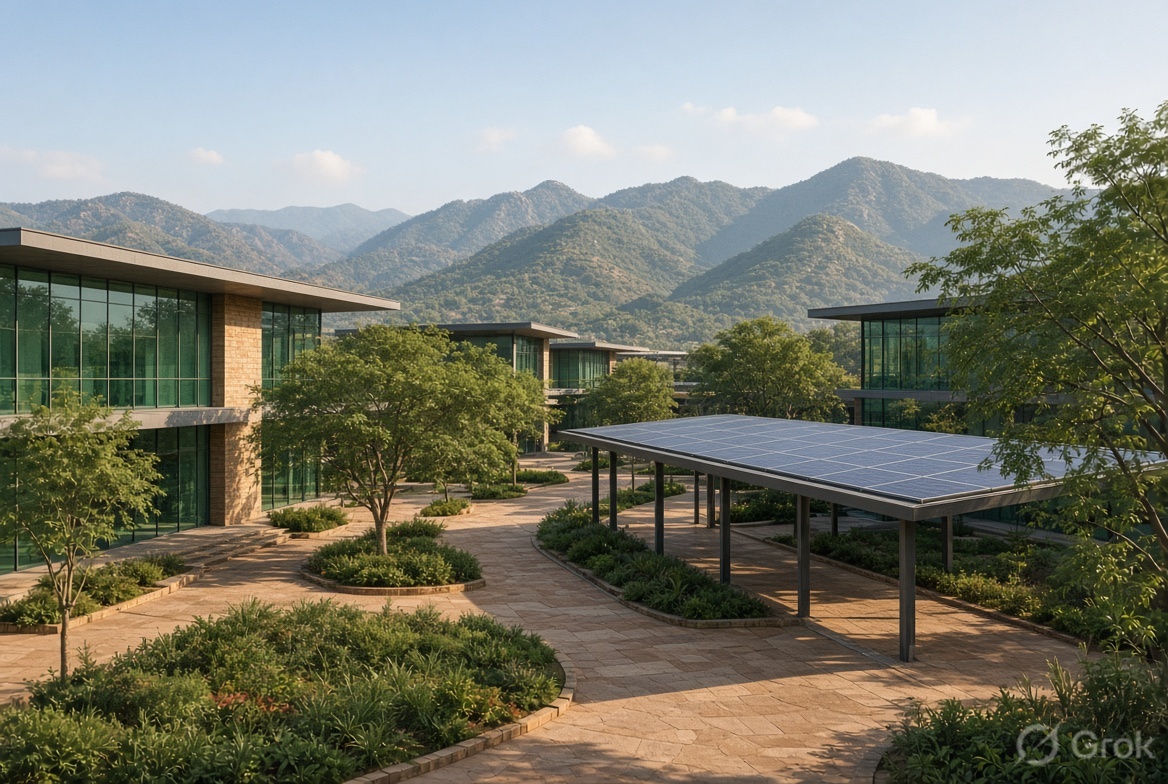 Proposed concept
Read the full story
Proposed conceptArtist impression · Proposed concept · Not allotted land