
A Japanese-Inspired Home, an Indian Welcome
Read the full story
A Japanese-Inspired Home, an Indian Welcome
Read the full storyA residence begins with drawings. A meaningful home begins with understanding how people live.
Briston’s team travelled to Japan to study residential life and architecture firsthand, according to the project account shared for this story. The purpose was to look beyond appearances: to understand how a home supports daily routines, how rooms relate to one another and how functionality can coexist with a sense of calm.
That learning journey gives Briston’s Neemrana vision a human starting point. Its ambition is to create a place where Japanese professionals can find familiarity, Indian families can discover a thoughtful interpretation of everyday living, and both can experience the warmth of belonging.
Briston's residential concept describes fully furnished Indo-Japanese wellness residences, with more than 260 proposed apartments across 1, 2 and 3 LDK configurations. LDK refers to living, dining and kitchen functions—the spaces around which much of a household’s day unfolds.
A morning can begin in the kitchen and continue over breakfast without separating the person preparing food from everyone else. An evening meal can lead naturally into conversation. The home becomes a setting for shared experience as well as private retreat.
Briston identifies intelligent layouts, balconies, natural light, ventilation and spatial harmony among its design priorities. Together, these establish the intended character of the residences: spaces that feel considered in use, with attention to movement, daylight and the relationship between indoors and outdoors.
Furnishing is part of that proposition. For someone arriving in Neemrana on a professional assignment, a furnished apartment could make the transition from travel to daily life easier. It offers the prospect of furniture and rooms conceived together. Briston's provides the furnished-home ambition; individual furniture, appliance and storage specifications will be defined through the project’s final documents.
The warmth of home also comes through food. Briston’s wider retail concept includes dining plazas, café and lounge sit-outs, and a proposed rooftop dining-and-lounge setting. These spaces give residents choices beyond their own kitchens: somewhere to meet a colleague, enjoy a family meal or introduce a visiting friend to the neighbourhood.
Within Briston, Japanese and Indian food experiences would be a natural direction to explore.
Wellness gives the residential experience another dimension. Briston’s published plans describe a clubhouse, wellness centres, swimming pools and sports courts; its retail material also identifies fitness, spa and business-centre facilities within the proposed clubhouse offering. The intention is to place recreation, restoration and practical convenience within the same wider environment.
The township describes theme gardens, tree-lined walking tracks, central greens and open plazas.

Nachi: The Precision Behind Movement, Made in Neemrana
Read the full story
Nachi: The Precision Behind Movement, Made in Neemrana
Read the full storyFor Neemrana, Nachi brings that world of precision into focus.
Nachi Technology India’s official website records its establishment in February 2012 as a wholly owned subsidiary of Japan’s Nachi-Fujikoshi Corporation. It identifies its manufacturing facility in Neemrana’s Japanese Industrial Zone as the foundation of its local production of bearings for the Indian market.
Japanese enterprise building an Indian production base to serve customers in India.
It also offers a useful way to understand Neemrana’s industrial identity. A town’s reputation grows through the capabilities established within it—the products its businesses make, the knowledge their work requires and the relationships they develop with customers.
Nachi’s own account places its Indian business within the automotive and industrial bearing sectors. Its Neemrana plant is listed at SP-86 in the Japanese Zone. These details turn a broad story about international manufacturing into a specific local address.
The company’s wider Indian offering also includes robotics solutions through group companies. That provides a separate opening for a leadership conversation about manufacturing’s future, while keeping the distinction clear between the Neemrana bearing operation and the group’s broader capabilities.
Nachi describes its Neemrana facility as a means of supplying the domestic market through local production. For the town, that represents an international business relationship taking physical form through a factory and a continuing manufacturing presence.

Kokoku Intech: Small Components, Serious Expertise and a Neemrana Address
51 companies (Embassy/JETRO, Oct 2024) — a voluntary survey.
Read the full story
Kokoku Intech: Small Components, Serious Expertise and a Neemrana Address
51 companies (Embassy/JETRO, Oct 2024) — a voluntary survey.
Read the full storyKokoku Intech offers specialised parts, technical knowledge and a confirmed manufacturing presence in Neemrana.
The company’s official facilities directory lists Kokoku Intech India’s Neemrana factory at plots SP2-39 and SP2-40 in the RIICO New Industrial Complex. The same listing identifies ISO 9001, ISO 14001, IATF 16949 and ISO 45001 certifications for the facility.
Kokoku’s corporate website describes its wider business as researching, developing and producing rubber parts, including automotive and medical applications. Those are group-level activities; the exact products manufactured in Neemrana should be established with the local operation before assigning applications to the Indian factory.
Kokoku Intech’s official Neemrana listing supplies the starting point. A product-led, people-centred feature can turn it into an engaging account of Japanese enterprise on Indian soil, one grounded in the precision of the work and the possibilities ahead.
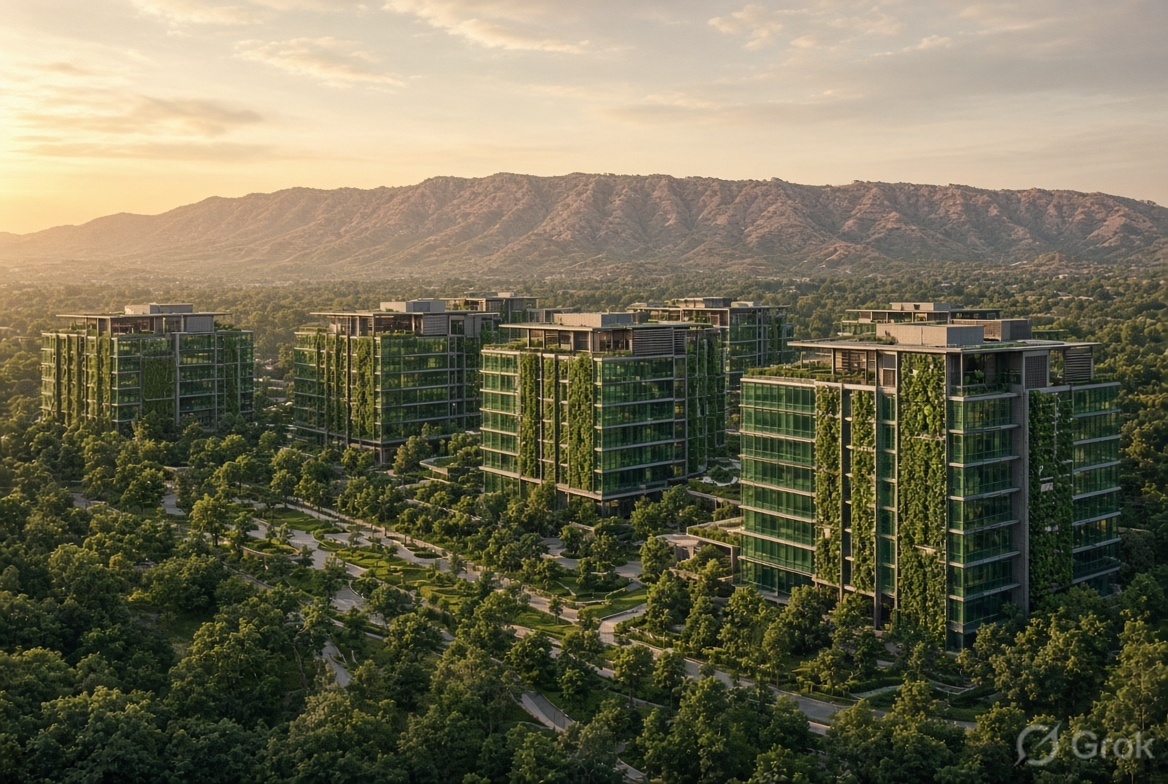 Proposed concept
Read the full story
Proposed conceptArtist impression · Proposed concept · Not allotted land

Emerald Valley: Where Solar Power Could Fuel Neemrana’s Compute Economy
Real water/mobility item, separate from the pitch.
Read the full story
Emerald Valley: Where Solar Power Could Fuel Neemrana’s Compute Economy
Real water/mobility item, separate from the pitch.
Read the full storyNeemrana’s next economic chapter is set to begin with a powerful connection: the energy to run advanced computing, the talent to use it and the businesses ready to turn it into practical value.
Emerald Valley has its education and skilling ambitions, the project is poised to develop a compute economy, a network of services that helps companies, researchers and entrepreneurs use processing power to design, analyse, simulate and build.
From a place of production to a place of intelligence
Computing becomes economically meaningful when someone uses it to solve a problem.
IndiaAI’s compute portal offers access to cloud-based computing resources for eligible researchers, students, startups, MSMEs and industry. It demonstrates that participation in the compute economy can begin through access to shared infrastructure, rather than ownership of an entire facility.
Solar power as part of the business architecture
The digital economy has a physical foundation. Processors require electricity, and their heat must be managed. The International Energy Agency identifies the relationship between computing and energy as central to the development of artificial intelligence.
For Emerald Valley, solar power could therefore become part of the operating model,
Solar would contribute when available, while the wider system would support the continuity that computing services require. The IEA identifies battery storage and clean-power procurement among the approaches being developed around data-centre demand.
The ambition should be useful computing supported by responsible energy planning.
A credible sustainable compute district would consider cooling, water, buildings and equipment together.