
Briston: Neemrana’s clean-air residential prototype
Read the full story
Briston: Neemrana’s clean-air residential prototype
Read the full storyBriston is not simply a managed residence or hospitality project, but it is a new model for ecological urban living in the SNB corridor. Instead of framing it around short stays or global professionals alone, the more distinctive story is about performance: how a future residential district can reduce its own environmental footprint while offering healthier, calmer and more liveable surroundings.
The idea is powerful because Briston is positioned as a low-emission, low-water-wastage address shaped by systems rather than slogans. Solar power, rainwater harvesting, treated-water reuse, dust control, water bodies, native planting and Miyawaki-style forest patches can together create a greener micro-environment and a more responsible pattern of urban growth. Briston is being built for an environment that tries to align housing, hospitality and biodiversity rather than placing them in conflict.
This is where the story becomes especially relevant to Neemrana. As the industrial belt grows, the question is no longer only where factories will stand. It is also what kind of neighbourhoods will surround them. Briston represents a more advanced answer, one where air quality, water responsibility and habitat value become part of the development conversation alongside comfort, design and market demand.
The most compelling line in the piece is not that Briston will magically be untouched by regional pollution, because no project in North India can honestly promise that every day of the year. The stronger and more believable claim is that design can still make a measurable difference. A project that reduces dust generation, reuses water, expands native green cover, incorporates solar energy and supports biodiversity can create a cleaner local experience and raise the standard for future development in Neemrana.

Nihon Parkerizing India: Neemrana’s invisible quality layer
Read the full story
Nihon Parkerizing India: Neemrana’s invisible quality layer
Read the full storyNeemrana is often described through the products that leave its factories viz air-conditioners, automotive parts, electronics and machinery. But some of the most important work in an industrial economy happens before a finished product is ever seen. Nihon Parkerizing India, which operates from the Majrakath Japanese Zone in Neemrana, represents that quieter but essential layer of industrial value, metal surface treatment, corrosion resistance and the chemistry that helps manufactured components last longer, perform better and move more reliably through production systems.
The company describes itself as a technology leader in surface modification for automotive parts, electric appliances and the steel industry. Its work includes supplying surface-treatment chemicals for cleaning substrates, adding corrosion resistance, creating a paint base, providing lubrication and supporting design features in manufacturing processes. That means Neemrana is not only a place where components are assembled; it is also a place where industrial durability is engineered at the molecular and process level.
This is a powerful story for Neemrana Signal because it shifts the local industrial conversation from visible scale to hidden sophistication. A well-finished surface resists rust, improves paint performance, supports smoother operation and extends the working life of a component. In a modern supply chain, those qualities affect safety, cost, reliability and customer confidence. The Neemrana unit also underlines another important truth about the corridor: it hosts not only production but also technical support, troubleshooting expertise and process knowledge that help manufacturers solve quality problems in real time.
This kind of company deepens the industrial ecosystem in a meaningful way. It creates opportunities for chemical handling, process engineering, quality assurance, line optimisation and industrial problem-solving. Neemrana’s future competitiveness will not be built only on large factory shells or highway access, but on specialised capabilities like these-the invisible quality layer that makes everything else stronger.

TPR Autoparts: Neemrana’s engine-precision story
Read the full story
TPR Autoparts: Neemrana’s engine-precision story
Read the full storyA town becomes industrially important not only when it makes visible products, but when it helps solve the hardest engineering questions inside them. TPR Autoparts Manufacturing India gives Neemrana precisely that kind of role. TPR’s official overseas-locations page identifies its Neemrana unit in the Majrakath Japanese Zone and says the business there manufactures and sells cylinder liners.
This opens the door to a much bigger story. Cylinder liners are among the critical parts that help engines withstand friction, heat and repeated mechanical stress. They are part of the precision environment that determines how efficiently an engine runs, how long it lasts and how well it performs over time. This means Neemrana contributes not only to vehicle production, but to the internal endurance of the systems that power mobility and machinery.
TPR’s Neemrana operation are presented as evidence that the corridor participates in the deep technical disciplines that keep engines reliable in the real world.
Companies like TPR build skills not only in fabrication, but in tolerances, materials performance, machining discipline, inspection and process consistency. These are the foundations of a mature manufacturing culture. A town that can support this kind of precision work becomes more valuable to future investors because it proves it can handle complexity, not just volume.

Beltecno India: from Neemrana to India’s water future
Read the full story
Beltecno India: from Neemrana to India’s water future
Read the full storyBeltecno India offers Neemrana Signal a story that reaches beyond the factory gate into one of the country’s most important long-term needs: water security. The company’s Neemrana factory in the Majrakath Japanese Zone manufactures stainless-steel panel tanks, and its own materials say these systems are built for industrial and commercial uses ranging from hospital drinking-water systems to thermal storage in data centres.
Beltecno says its SS304 and SS316L tanks can be customised from 1,000 litres to over 1 million litres, and that the business draws on more than 75 years of Japanese engineering while manufacturing from Neemrana for customers across India. This allows a strong editorial reframing. Beltecno is not just making tanks, it is helping design the physical infrastructure that stores, protects and manages water in modern India. Clean water in a hospital, reliable water in a housing campus, process water in a factory and stored thermal efficiency in a data centre all depend on engineered systems that do their job quietly and consistently.
That makes Beltecno a particularly valuable Neemrana story because it links industrial production with public utility, hygiene and resilience. Water storage is often treated as background infrastructure until it fails. Yet corrosion resistance, contamination control, low maintenance and long operating life are central to healthy buildings and dependable operations. Beltecno’s Neemrana manufacturing base demonstrates that the corridor contributes to these practical, high-value systems as part of India’s wider urban and industrial growth.
The larger regional meaning is compelling. As the SNB corridor expands, the demand for durable water infrastructure will grow across industry, hospitality, education, housing and healthcare. A Neemrana-based manufacturer specialising in robust storage systems shows that the region’s industrial future is not only about consumer products or automotive supply chains. It is also about producing the infrastructure that helps fast-growing places function well, safely and sustainably.
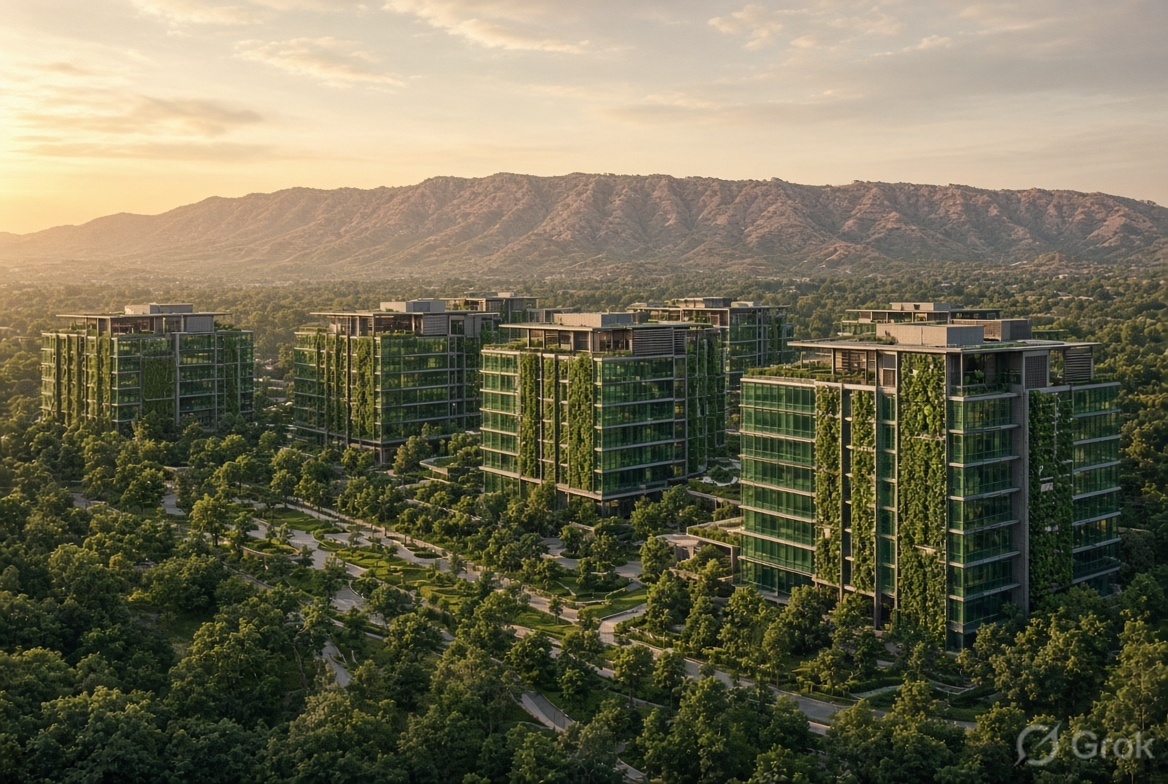 Proposed concept
Emerald Valley: Neemrana’s biodiversity-jobs story
Read the full story
Proposed conceptEmerald Valley: Neemrana’s biodiversity-jobs story
Read the full storyArtist impression · Proposed concept · Not allotted land
Emerald Valley can become one of the most original long-term development stories in the Neemrana region if it is framed not only as an ecological idea, but as a livelihood engine. The founder-led vision already centres on native planting, biodiversity restoration, groundwater improvement and cooler local conditions. The fresh step is to show that restoration can also create meaningful work, skills and enterprise across the corridor.
That changes the tone of the story in an important way. Instead of treating ecology as decoration, Emerald Valley can be written as an economy of care: nurseries for native species, seed collection and propagation, ecological monitoring, restoration landscaping, biodiversity walks, habitat maintenance and local stewardship programmes. Each of these activities can create jobs, train young people and build practical knowledge rooted in Neemrana’s own landscape rather than imported ideas.
This is an especially important narrative for a place known mainly for manufacturing. Industrial growth is essential, but a mature regional economy also creates value through land healing, climate adaptation and ecological services. Emerald Valley can therefore stand for a broader model of development, one in which the future of Neemrana includes not just what it builds on the land, but how it restores the land as it grows.
The Emerald Valley is ecological, economic and civic at once. It suggests that the SNB corridor can become more ambitious than a conventional industrial stretch. It can become a place where biodiversity restoration itself is treated as an investment in resilience, identity and long-term prosperity.