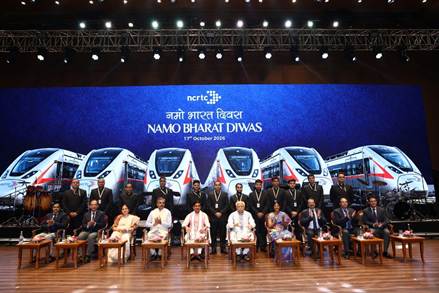
Namo Bharat’s 4.5-crore milestone points towards Neemrana’s connected future
Read the full story
Namo Bharat’s 4.5-crore milestone points towards Neemrana’s connected future
Read the full storyNamo Bharat has given India a powerful demonstration of what modern regional rail can achieve. In three years, the 82-km Delhi-Ghaziabad-Meerut corridor has recorded more than 4.5 crore passenger journeys, a remarkable public-transport milestone that reflects growing trust in fast, safe and seamless regional travel.
At Namo Bharat Diwas 2026, Union Housing and Urban Affairs Minister Manohar Lal Khattar highlighted the scale of that success: the corridor now serves more than 1.1 lakh commuters every day and has recorded a highest single-day ridership of around 1.68 lakh passengers. The service began on a 17-km priority stretch between Sahibabad and Duhai Depot in October 2023; the full corridor was dedicated to the nation on 22 February 2026.
The achievement matters because it proves that people embrace regional rail when it is frequent, dependable and designed around daily life. Namo Bharat brings workplaces, colleges, markets and business districts within easier reach, while giving commuters more time and greater convenience in their day.
This 4.5 passengers milestone carries an especially encouraging message. The Delhi-Gurugram-Behror Namo Bharat corridor is among the priority corridors expected to move toward approval, placing the SNB region within the next phase of India’s regional-rail vision. Once services reach the Delhi-Gurugram-SNB-Behror corridor, Neemrana can connect more directly with the daily movement of professionals, students, entrepreneurs, factory teams and visitors across Delhi NCR said a government press release issued by pib.gov.
Going by the average 11 lakh passengers daily, A Delhi-Gurugram-Behror service serving Gurugram’s employment centres, the BawalRewari region and the Shahjahanpur-Neemrana-Behror industrial corridor can create a similarly strong-and potentially even wider-regional travel market as the route matures said the government of India press release.
The proposed Bawal–Behror section is currently estimated at Rs.7747 crore, including land-related requirements, it includes planned stations at the SNB border, Shahjahanpur, Neemrana and Behror. Separate reporting has placed the wider Delhi-Gurugram-SNB-Alwar corridor’s proposed cost at about Rs.37000 crore, while the later Bawal-Behror extension proposal was reported at roughly Rs.8000 crore, taking the broader corridor estimate toward Rs.43000 crore.
Namo Bharat’s first three years have shown what regional rail can accomplish when people make it part of their everyday lives. The 4.5-crore journey milestone is a promising signal for the next chapter: a future in which Neemrana, Behror and the wider SNB corridor stand closer to Delhi NCR’s opportunities than ever before.

Why Neemrana Is Cleaner Than Delhi, Noida, Ghaziabad, Greater Noida
Read the full story
Why Neemrana Is Cleaner Than Delhi, Noida, Ghaziabad, Greater Noida
Read the full storyNeemrana is obviously cleaner than Delhi, particularly during Delhi’s worst winter-smog episodes. Neemrana is a real advantage from much lower concentration of urban emissions, has a different exposure to the wind and winter trapping conditions that concentrate pollution over Delhi.
Delhi is a vast, dense emissions centre: heavy traffic, construction activity, road dust, residential and commercial fuel use, industrial sources and waste-burning hotspots all release pollution into the same urban air mass. Delhi’s own environmental department identifies particulate pollution and gases from these sources, with wind, humidity and temperature determining how intensely they build up.
Neemrana has industrial activity, freight movement and local emission sources of its own but most industries are greentech and environment friendly.
The very location of Neemrana matters. Neemrana lies southwest of Delhi, closer to the Aravalli landscape and away from the densest built-up core of Delhi-Noida-Ghaziabad. The Aravalli system has historically helped moderate the eastward movement of desert dust and influences local wind patterns across the region.
Delhi works like the winter 'lid'. The major difference is atmospheric behaviour in winter. On cold, calm nights, dense cold air settles close to Delhi’s surface while warmer air rests above it. This temperature inversion acts like a lid, preventing smoke, dust and exhaust from rising and dispersing.
Delhi is also within the broader Indo-Gangetic Plain, where weak winds and shallow winter mixing height can hold pollution over a very large urbanised region. In winter 2025-26, Delhi recorded an average PM5 level of AQI often reaching 400-500 micrograms per cubic metre, with 18 severe-air-quality days and 87 very-poor days.
Analysis of the post-stubble period in December 2025 found that 65 percent of Delhi’s lowest particulate matter comes from NCR districts and regions beyond Delhi’s boundary, showing why the issue must be understood as an airshed challenge rather than a city-only problem.
Northwesterly winds can carry air from Punjab, Haryana, Rajasthan and western Uttar Pradesh toward Delhi. Depending on wind speed, these flows bring dust or smoke.
Neemrana does not receive Delhi’s pollution plume as consistently as Noida and Greater Noida often do.
This is why Neemrana remains clearer even when east-NCR locations are heavily affected its position is generally to Delhi’s southwest, rather than in the principal eastward downwind path from Delhi.

PMI Electro Mobility: Ghiloth’s electric-bus opportunity-33000 electric buses annual production
Read the full story
PMI Electro Mobility: Ghiloth’s electric-bus opportunity-33000 electric buses annual production
Read the full storyGhiloth could become the home of Rajasthan’s first electric-bus manufacturing plant, placing the Neemrana-Ghiloth industrial belt at the centre of India’s fast-growing clean-mobility economy. PMI Electro Mobility Solutions has been linked with a proposed Rs.1,200-crore facility on 65 acres allocated by RIICO, creating a major new industrial opportunity for the region.
Electric-bus production can build an ecosystem of vehicle assembly, battery packs, power electronics, wiring harnesses, fabrication, testing, charging systems, maintenance and fleet-support services. Each layer creates room for suppliers, technicians, logistics firms, training institutes and local entrepreneurs.
The project can open a pathway into the skills that will define the next manufacturing era: automation, diagnostics, electrical systems, battery safety, quality control and green engineering. It can help turn the corridor’s industrial identity from conventional manufacturing strength into a visible contributor to India’s low-emission transport future.
The project is also a strong signal for future investors. A successful e-bus facility may attract component makers, charging-infrastructure providers, software and fleet-management firms, and recycling or circular-economy businesses. Ghiloth’s advantage is that it can grow as an integrated industrial location-where a bus is not merely assembled, but supported by a local network of engineering, services and skilled people.

DMICDC Neemrana Solar Power: the clean-energy system already supporting industry
Read the full story
DMICDC Neemrana Solar Power: the clean-energy system already supporting industry
Read the full storyNeemrana’s Japanese Zone is home to more than a solar plant-it is home to one of India’s early industrial smart-microgrid demonstrations. The project combines 6 MWp of solar capacity with a smart microgrid model, designed through India–Japan cooperation to show how renewable generation and backup systems can support dependable power for manufacturing.
The asset is managed by NICDC Neemrana Solar Power Limited, formerly known as DMICDC Neemrana Solar Power Company Limited, a wholly owned subsidiary of the National Industrial Corridor Development Corporation. RIICO’s records list the company’s allotted plots in the Majrakath Japanese Zone, while the project occupies about 36 acres in the Japanese Investment Zone.
The model is particularly important because it separates the project into two practical energy roles. A 5-MW solar plant feeds power into the state grid, while a 1-MW solar component was designed with diesel-generator backup and smart-grid controls for industrial consumers in the Neemrana Industrial Park.
The larger story is industrial resilience. Manufacturers need predictable electricity for automated lines, sensitive equipment, quality systems and production schedules. The solar project shows that clean energy can be integrated into an industrial ecosystem not as a symbolic add-on, but as part of a wider approach to energy planning, monitoring and reliability.
It is also an example of the depth of India–Japan collaboration in Neemrana. The project was developed with Japanese participation, and its equipment package included technology and components associated with firms such as Hitachi, Kyocera, Sharp, Solar Frontier and Kaneka.

Briston promotes clean-living ecology
Read the full story
Briston promotes clean-living ecology
Read the full storyBriston is being envisioned as more than a Japanese-managed residential and hospitality destination in Neemrana. Supported by the wider ecological vision of Emerald Valley, the project can aim to demonstrate how international-standard living, water responsibility, clean energy and biodiversity can grow together in one place.
The development’s environmental direction is ambitious, a low-emission, water-sensitive community designed to reduce waste at every stage of daily life. Its ecology-led model can bring together rooftop solar power, rainwater harvesting, treated-water reuse, low-water landscaping, water bodies and careful waste segregation—so that resources are circulated rather than casually discarded.
A key feature can be the creation of Miyawaki-style native forests. Dense plantations of locally suitable trees and shrubs can help build a greener microclimate, support birds, butterflies and pollinators, and create a visual and environmental buffer around homes, restaurants and common spaces. Along with restored water bodies, native planting can help recharge groundwater, improve soil health and make the landscape more resilient through hot and dry months.
Briston’s connection with Emerald Valley gives this vision a deeper purpose. Briston’s proposed ecology programme focuses on native species, biodiversity recovery, groundwater improvement and cooler local conditions. Briston offers the lived expression of that philosophy, a place where residents and visitors experience an environmentally responsible Neemrana not as an abstract promise, but through cleaner surroundings, green walks, water-sensitive landscapes and a stronger relationship with nature.
The aspiration is to create a community with very low local particulate pollution and an AQI that can remain below 50 during favourable weather conditions, far better than heavily congested urban centres.
Clean water is equally central to Briston's ambition. Rainwater harvesting, groundwater recharge, wastewater treatment and reuse for landscaping can reduce dependence on fresh-water extraction while ensuring that water is used responsibly. Drinking-water quality, however, must be protected through tested treatment systems and regular independent monitoring, clean surroundings alone do not guarantee potable water.
Briston offers a new kind of Neemrana address the one designed around comfort without excess, development without ecological neglect, and offering hospitality that respects the land that supports it. The strongest promise is not 'zero impact' but measurable progress, a community that publishes its solar generation, water reuse, native-plant survival, biodiversity sightings, waste diversion and air-quality readings as it grows.