
Tokai Imperial Hydraulics: Neemrana’s Link to India’s Heavy-Machinery Growth
Read the full story
Tokai Imperial Hydraulics: Neemrana’s Link to India’s Heavy-Machinery Growth
Read the full storyAt Neemrana’s Japanese Investment Zone, Tokai Imperial Hydraulics India represents a specialised side of industrial growth. The engineering systems that allow large machines to lift, dig, load, move and perform under demanding conditions. The company manufactures high-pressure hydraulic hoses and related hose-pipe products, components that carry pressurised fluid through construction equipment, civil-engineering machinery and other heavy-duty industrial applications.
Hydraulic hoses may not be visible to most people, but they are fundamental to modern infrastructure. Excavators, cranes, loaders, road-building equipment and many industrial machines rely on hydraulic power to convert fluid pressure into controlled force and movement. The hoses in these systems must withstand pressure, vibration, temperature changes and repeated use. Reliability is essential because every machine depends on a network of precisely engineered connections to operate smoothly.
Tokai Imperial’s Neemrana operation began production in 2015, establishing the corridor as a location for Japanese-linked engineering manufacturing beyond automobiles and consumer products. The facility is located at the Japanese Zone in RIICO’s Majrakath industrial complex, with public business records identifying its address as SP2-93 to SP2-95. Its presence adds depth to Neemrana’s manufacturing identity by connecting the town with India’s expanding construction, industrial-equipment and infrastructure economy.
India’s need for modern roads, logistics parks, housing, industrial estates, warehouses and urban infrastructure creates a long-term market for construction and civil-engineering machinery. Each new project requires equipment that works consistently in demanding environments. A local manufacturing base for high-pressure hose systems therefore becomes part of the larger supply chain that supports national development.
For Neemrana, the company’s story also reflects the value of industrial specialisation. Manufacturing hydraulic hoses involves material control, fittings, reinforcement, assembly, testing and quality assurance. It requires technicians who understand machinery, production processes and the importance of consistency. Such work strengthens the local base of skilled manufacturing talent and creates opportunities for suppliers, maintenance teams, transport firms, packaging providers and quality-control professionals.
The company’s location within the Japanese Zone creates further advantages. Neemrana offers industrial infrastructure, proximity to the Delhi–NCR market and access to a growing network of automotive, engineering and manufacturing companies. This ecosystem allows specialised factories to operate alongside other Japanese and international businesses while drawing on shared strengths in logistics, talent and industrial services.
Tokai Imperial Hydraulics is an example of the quiet but critical manufacturing that makes larger development possible. Its hoses may work inside machines rather than on showroom floors, but they help give heavy equipment the strength and control to build roads, industrial projects and modern infrastructure. From Neemrana, the company is contributing to the machinery behind India’s growth story

E&H Precision India: The Neemrana Factory Built for Micron-Level Manufacturing
Read the full story
E&H Precision India: The Neemrana Factory Built for Micron-Level Manufacturing
Read the full storyE&H Precision India is one of Neemrana’s strongest examples of high-volume, high-accuracy engineering. From its factory in the Phase III Japanese Zone at Majrakath, the company manufactures precision metal-cutting components for automobiles, motorcycles, air-conditioners and other industrial applications. Its work is a reminder that some of the most important products in manufacturing are also the smallest-components that must meet exact dimensions, perform reliably and fit perfectly inside larger systems.
The Neemrana facility is substantial. E&H Precision, its Indian plant occupies 19,074 square metres, employs about 540 people and is equipped with 282 CNC/CAM lathes. It is certified to ISO 9001, IATF 16949 and ISO 14001 standards, combining quality management, automotive-system requirements and environmental-management practices. This scale makes it a major precision-engineering presence in the corridor.
The company specialises in metal-cutting work that demands close control over dimensions and repeatability. Its global product range includes components for carburettors, injectors, turbochargers, common rails and brake systems, as well as applications in motorcycles and air conditioners. E&H says it can achieve ultra-precision production at sub-micron accuracy, a level of manufacturing that highlights the technical capability now present in Neemrana.
The significance is easy to understand. A vehicle or air-conditioning system may contain hundreds of parts, but many cannot work unless small components are made consistently and accurately. A tiny variation in a shaft, fitting or machined element can affect performance, durability or safety. Precision factories solve that problem through advanced machines, disciplined processes, inspection and trained people.
E&H Precision’s Neemrana factory also illustrates the employment potential of advanced manufacturing. Its operation creates scope for CNC operators, production engineers, tooling specialists, quality-inspection teams, maintenance engineers and supply-chain professionals. It helps build a local culture of technical learning in which young workers can develop skills that are relevant not only to one company but across India’s growing automotive, appliance and industrial sectors.
The company’s presence reinforces Neemrana’s evolution beyond a location for land and plants into a hub for specialised manufacturing capability. It shows that global-quality engineering can be performed in Rajasthan, close to Delhi–NCR and within reach of major customers and supplier networks.
E&H Precision India is therefore more than a machine shop. It is a factory where technology, training and manufacturing discipline come together to make the exact components behind everyday mobility, cooling and industrial performance. Its success demonstrates the kind of technical depth that gives Neemrana a durable place in India’s future manufacturing economy.

JDaiichi N Horizon Autocomp: Fastening Neemrana to India’s Automotive Future
Read the full story
JDaiichi N Horizon Autocomp: Fastening Neemrana to India’s Automotive Future
Read the full storyA car, motorcycle or industrial machine is held together by thousands of components, but few are as essential as the fasteners that secure them. Bolts, nuts and specialised fastening systems may appear small, yet they are the hardware that keeps engines, chassis, assemblies and industrial equipment working safely and reliably. At Neemrana, Daiichi N Horizon Autocomp has built its business around this vital industrial function.
Daiichi N Horizon Autocomp is part of Japan’s Daiichi Kogyo group, whose manufacturing history dates to 1946. The Neemrana company is a joint-venture-led automotive and industrial-components business with capabilities in automobile-parts design and manufacturing, stamping, welding and fasteners. Its factory was established in Neemrana in 2011, and production of fasteners began in September 2013.
That makes the company part of the early industrial story of Neemrana’s Japanese manufacturing corridor. As the area developed into a home for automotive suppliers, engineering firms and Japanese businesses, Daiichi N Horizon helped establish the supply base needed to support larger manufacturing activity. Its products and processes sit at the foundation of industrial assembly: holding parts together with consistency, strength and precision.
Fastener manufacturing is a discipline of exacting standards. Automotive and industrial customers require parts that meet defined dimensions, material specifications, strength ratings and quality requirements. A fastener must perform under heat, vibration, load and repeated use. That means the production process depends on material knowledge, forming, threading, surface treatment, inspection and dependable quality control.
The Neemrana plant’s capabilities in stamping and welding broaden the story further. It shows that the company is not limited to a single product category but forms part of the wider component-making ecosystem serving automotive and industrial customers. Such facilities support the supply chains of vehicle makers, equipment manufacturers and Tier-1 suppliers, while also creating demand for local logistics, packaging, maintenance, machining and technical-support services.
Daiichi N Horizon is a good example of how global industrial relationships can create long-term local value. A Japanese-linked company brings manufacturing systems and quality discipline; the local facility creates work, develops technicians and links Rajasthan to national supply chains. Over time, the result is an industrial ecosystem in which specialised companies can operate close to customers and alongside other engineering businesses.
The company chose Neemrana in the early years of the Japanese Zone, started production here and continues to be identified with the automotive-components segment. Its presence signals that the corridor offers more than a location; it offers the infrastructure, connectivity and industrial environment needed for sustained manufacturing.
Daiichi N Horizon Autocomp’s contribution may be measured in components that are rarely noticed, but its importance is clear. From Neemrana, it helps fasten together the machinery, vehicles and industrial systems that move India forward.

Nissin Brake India: Engineering Confidence Into Every Journey
Read the full story
Nissin Brake India: Engineering Confidence Into Every Journey
Read the full storyFew automobile components are more important than brakes. Whether a rider is navigating a crowded city street, a commuter is travelling on a highway or a family is making a long-distance journey, dependable braking systems are central to confidence on the road. Nissin Brake India represents Neemrana’s connection to this critical side of mobility: the engineering of systems designed to help vehicles slow down, stop safely and respond predictably.
Nissin is internationally associated with braking technology for two-wheelers and automobiles, and its Neemrana presence places the industrial corridor within the supply chain for safety-critical mobility components. Neemrana’s Japanese industrial zone has grown as a location for automotive and engineering businesses, supported by RIICO-developed infrastructure, national-highway connectivity and proximity to Delhi–NCR. In this setting, a brake-systems manufacturer is a natural fit.
Braking technology is much more than a lever, pedal or disc. It involves carefully designed systems that bring together calipers, master cylinders, brake fluid pathways, pads, discs and other precision parts. These components must work together reliably in heat, rain, traffic, changing road surfaces and long periods of use. Their development requires materials engineering, machining, assembly, testing and quality systems designed around consistency.
The company associated with braking systems strengthens the corridor’s identity as a mobility-manufacturing destination. The town is home to a growing mix of Japanese and international firms making automotive components, motors, safety systems, precision parts and industrial products. Nissin’s place in this ecosystem reflects how the corridor supports not only visible vehicle products but also the technologies that underpin everyday road safety.
The factory’s contribution extends beyond its immediate products. Automotive-component manufacturing creates work for engineers, machine operators, quality inspectors, maintenance professionals, logistics teams and local suppliers. It encourages young people to build practical skills in production discipline, measurement, process control and safety-led engineering. These skills can be used across a broad range of manufacturing industries.
There is also a wider national context. India remains one of the world’s largest two-wheeler markets, and the continued evolution of vehicle standards, rider expectations and road-safety awareness raises the value of dependable braking technology. As mobility changes, component manufacturers with a strong focus on quality and safety can help support the next phase of the sector’s growth.
Nissin Brake India’s Neemrana story is therefore one of quiet assurance. It represents the kind of engineering that consumers may rarely see but trust every time they travel. By hosting brake-system manufacturing within its Japanese industrial ecosystem, Neemrana is helping build the reliable mobility infrastructure that supports India’s roads, riders and future automotive growth.
 Proposed concept
Emerald Valley: A Future-Ready Talent and Ecology Vision for Neemrana
A proponent's vision — read against what the corridor actually has.
Read the full story
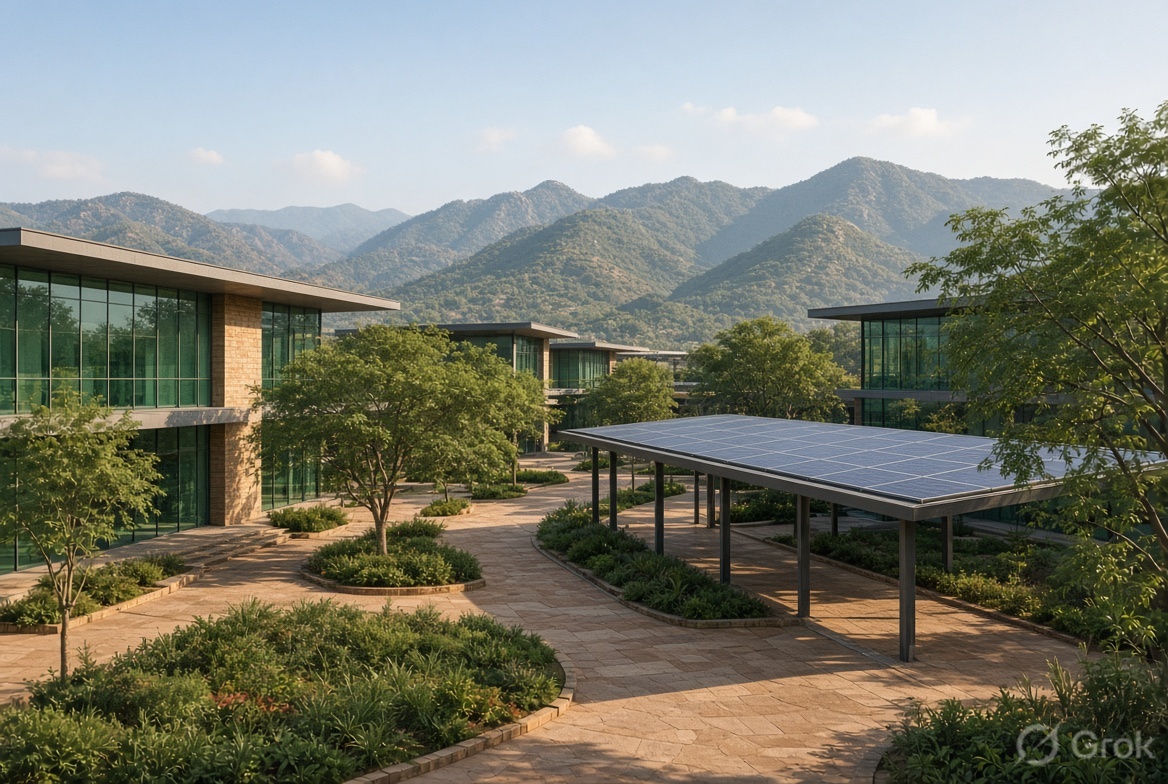
Proposed conceptEmerald Valley: A Future-Ready Talent and Ecology Vision for Neemrana
A proponent's vision — read against what the corridor actually has.
Read the full storyArtist impression · Proposed concept · Not allotted land
Neemrana’s next development story need not be defined only by industrial plots, factories and housing. Emerald Valley is being envisioned as a future-focused initiative that brings together two priorities increasingly important to global businesses and communities, skilled people and a healthier environment.
At the heart of the concept is an ambitious education and employment vision. Emerald Valley aims to help train up to 100,000 students through practical, project-based and industry-linked learning. Instead of relying only on classroom instruction, students would work on assignments, technical challenges and projects connected to the real needs of factories, technology businesses, engineering companies and service enterprises operating in the Neemrana corridor.
The purpose is simple to help young people become closer to employment-ready before they join a company. Recruitment is only the beginning of a long process. New employees often need orientation, technical training, mentoring, supervised project work and time to understand systems, standards and workplace discipline. This requires investment by companies in trainers, equipment, management time and internal learning programmes. It can also delay the point at which a new employee becomes fully productive.
Emerald Valley’s proposed project-based learning model seeks to reduce that gap. Students can learn not only a subject, but also how to apply it. An engineering student could work on a factory-efficiency challenge. A technology student could help build a digital tool for inventory, quality monitoring or energy management. A design student could participate in product, packaging or user-experience assignments. A student interested in sustainability could work on water conservation, waste reduction, native landscaping or environmental data collection.
The result could be a talent pool that understands real workplace expectations before entering the workforce. For companies, this means access to candidates who have already experienced projects, deadlines, team coordination, problem-solving, communication and practical use of technology. That can reduce the time and cost needed for basic training while helping employers deploy new talent more quickly.
The opportunity is particularly relevant to Neemrana. The corridor already has Japanese, Korean, Indian and international manufacturing companies across automotive components, engineering, consumer products, industrial systems and allied services. As this ecosystem grows, it will require technicians, designers, software professionals, quality specialists, maintenance teams, supply-chain executives, sustainability managers and project leaders. Emerald Valley’s proposed learning model can create a direct bridge between those industry needs and the aspirations of students from Rajasthan, Delhi–NCR and neighbouring states.
But Emerald Valley’s story is not only about skills. It also seeks to place environmental restoration at the centre of future development. The vision includes protecting and rebuilding Neemrana’s ecological character through native planting, biodiversity restoration, improved landscape design, cooler local microclimates and stronger groundwater recharge.
Native trees and plants can help create shade, support birds and pollinators, reduce dust, improve soil health and make outdoor spaces more liveable. Water-sensitive landscaping, recharge systems and conservation planning can help strengthen long-term water resilience. For an industrialising region, these are not merely aesthetic features; they are part of creating a healthier and more sustainable environment for workers, families and businesses.
Emerald Valley therefore proposes a different model of growth. It imagines a Neemrana where students learn through real industry projects, companies find more prepared talent and development works with the local environment rather than apart from it. If translated into partnerships, training facilities and measurable ecological action, the initiative can give Neemrana a distinctive identity: an industrial destination building both the skilled workforce and resilient landscape needed for the future.

Briston The Global Neemrana : A new address is rising for the people building Neemrana’s future
Real water/mobility item, separate from the pitch.
Read the full story
Briston The Global Neemrana : A new address is rising for the people building Neemrana’s future
Real water/mobility item, separate from the pitch.
Read the full storyBriston is building as a premium managed-residences destination for a new generation of global professionals, industrial leaders, expatriate families, corporate guests and ambitious homebuyers. As Neemrana grows into one of India’s most important international manufacturing corridors, Briston is designed to bring together the privacy of a home, the ease of a hotel and the energy of a modern social destination.
This is not simply a residence. It is a serviced lifestyle created for people who expect more from the place they live.
Arriving after a long business day to a professionally managed environment where service, security, comfort and hospitality work seamlessly together. A welcoming reception. A responsive concierge. Carefully maintained residences. Housekeeping support. In-residence dining. Efficient maintenance. A clubhouse that brings together work, wellness, recreation and community.
At Briston, every detail is intended to make daily life easier.
The project is positioned around the managed-residence model associated with leading international hospitality brands. Discussions with established operators, including the Taj Group and Singapore-based CapitaLand’s serviced-residence brands such as Ascott and Citadines, reflect Briston’s aspiration to bring five-star operating standards to Neemrana, subject to final agreements and announcements.
Managed residences create a different kind of ownership and living experience. Residents can enjoy the space and independence of a private home, supported by professional teams that manage the wider environment. From reception and security to housekeeping, engineering support, guest handling and common-area maintenance, the focus is on a consistently elevated experience.
Briston offers a refined base for senior leaders, visiting teams, consultants, technical specialists and international delegations. It provides a well-managed community where comfort, privacy and service come together. For investors, it represents a professionally positioned residential opportunity within an industrial destination that is attracting global attention.
Briston is also conceived as a destination for dining and connection. Planned Japanese, Korean and Asian food concept, including names such as Haru and My Asiana, can bring international flavours closer to Neemrana’s growing business community. From a business lunch with visiting partners to an evening meal with family, dining is expected to become an important part of the Briston experience.
The clubhouse will add another dimension: a place to work, meet, recharge and celebrate. Fitness and wellness spaces, leisure facilities, meeting areas, private events and community programming can create a lifestyle environment that goes far beyond an ordinary residential development.
As Japanese and Korean manufacturing expand, and as engineering, technology and services build around the corridor, Neemrana needs living infrastructure that matches its industrial ambition. Briston is being imagined to meet that need.
Because global investment needs more than industrial space. It needs a place where people can live well, work confidently and belong.
Briston. The managed-residence lifestyle for Neemrana’s global future.