
Ashimori India: Neemrana’s Factory for Safer Journeys
Third plant (~JPY 10bn) tracks to Sep 2026 completion.
Read the full story
Ashimori India: Neemrana’s Factory for Safer Journeys
Third plant (~JPY 10bn) tracks to Sep 2026 completion.
Read the full storyEvery time a passenger fastens a seatbelt or relies on an airbag in an emergency, a highly engineered safety system is at work. In Neemrana’s Japanese Investment Zone, Ashimori India Private Limited is part of that important automotive-safety manufacturing story. The company’s Neemrana unit manufactures and sells seatbelts, airbags and interior parts for automobiles from Plot SP2-11 at the RIICO New Industrial Complex, Majrakath.
Ashimori Industry is a Japanese automotive-safety group with manufacturing operations in India, Thailand, China, Mexico and South Korea. Its international presence reflects a simple truth about modern mobility: vehicle safety systems must meet high standards wherever cars are designed, assembled and driven.
At Neemrana, the factory gives Rajasthan a place in the value chain of safer vehicles. A seatbelt may look simple to a passenger, but it combines webbing, retractors, buckles, mechanical hardware, assembly systems and rigorous quality checks. Modern restraint systems can also use pretensioner technology, designed to restrain occupants at the moment of an impact.
The plant’s product range goes beyond seatbelts. Ashimori India is also identified by its parent group as a manufacturer of airbags and automobile interior parts. This places Neemrana inside a wider safety ecosystem that includes frontal, side, curtain and pedestrian-protection airbags, as well as interior systems that contribute to occupant comfort and protection. Ashimori’s technology portfolio has included power sunshades, which allow users to regulate rear-window light using a switch.
This is a positive example of Japanese precision manufacturing becoming part of India’s automotive future. The growth of passenger vehicles, higher expectations around safety and the wider adoption of electronic and safety systems all create room for factories that can produce reliable, carefully tested components.
The broader opportunity extends outside the factory gate. Automotive-safety manufacturing can support work for textile and webbing suppliers, metal-component makers, plastic moulders, packaging firms, logistics companies, maintenance teams and quality-testing specialists. It can also create valuable roles for production technicians, engineers, quality professionals and apprentices.
Ashimori India represents a kind of manufacturing that deserves more attention- it is not always visible to the public, but it directly contributes to safer travel for millions of people. From its Neemrana base, the company shows how the Japanese Zone is helping turn Rajasthan into a location where global automotive technology meets Indian manufacturing talent.

Imasen Manufacturing India: Building the Comfort Inside the Car
Supplementary DPR and funding under Rajasthan review.
Read the full story
Imasen Manufacturing India: Building the Comfort Inside the Car
Supplementary DPR and funding under Rajasthan review.
Read the full storyA modern car is more than an engine, wheels and body panels. It is also a carefully designed space where passengers sit, travel, rest and feel secure. At Neemrana’s Japanese Investment Zone, Imasen Manufacturing India Private Limited contributes to this less visible but essential side of mobility through automotive components including seat adjusters, car seats and recliner assemblies.
Imasen Manufacturing India was incorporated in November 2007 and operates from plots SP2-18, SP2-19 and 18(A) in the New Industrial Complex, Japanese Investment Zone, Neemrana. It is a subsidiary of a foreign company and remains active in motor-vehicle-parts manufacturing.
The company’s product categories offer a clear picture of its role in the automotive supply chain. It is associated with seat adjusters, car seats, recliners and recliner assemblies—components that help determine how a driver or passenger sits, adjusts position and experiences comfort during a journey. Other corporate listings identify its activity in relays, seat adjusters and lamps, underlining the breadth of engineered automotive components linked to the Neemrana operation.
A seat-adjustment mechanism is a small but important piece of engineering. It must remain strong, reliable and easy to operate over years of daily use. A recliner mechanism must allow controlled movement while holding its position securely. Such products involve metal fabrication, welding, fixtures, assembly, testing and quality control—the everyday industrial disciplines that give Neemrana’s Japanese Zone its manufacturing depth.
The company’s local plant leadership also highlights the operational focus on frame development, welding cells and fixtures. That creates a strong human story for Neemrana Signal: technicians, welders, quality inspectors and engineers working together to make the inside of India’s vehicles safer and more comfortable.
As India’s car market develops, the demand for better seating, more comfort features, improved ergonomics and higher-quality interiors will continue to grow. Electric vehicles may also create new possibilities for flexible interiors, lighter structures and passenger-focused cabin design. Neemrana is well positioned to participate because it already has automotive factories, Japanese management systems, supplier networks and access to the Delhi–NCR manufacturing market.
Imasen’s story is ultimately about how a factory in Rajasthan contributes to the experience of millions of journeys. From seat frames to recliners and adjusters, its Neemrana operation helps make India’s vehicles not only functional, but more comfortable, usable and refined.

Oiles India: Helping Machines Move Smoothly From Neemrana-The Best Bearing Technology In the World
Effluent-treatment headroom checked as units grow.
Read the full story
Oiles India: Helping Machines Move Smoothly From Neemrana-The Best Bearing Technology In the World
Effluent-treatment headroom checked as units grow.
Read the full storySome of the most important products made in an industrial economy are the ones people rarely see. Bearings, bushes and friction-control components sit inside vehicles, machinery and industrial systems, helping parts move smoothly, reliably and safely. At Neemrana, Oiles India Private Limited is part of this precision-engineering story.
Oiles India has been registered in Neemrana since 2014 and is identified as a supplier of seal bearings and pivot bushes. These components may be compact, but their role is large. They help reduce friction between moving parts, support load-bearing movement and contribute to the durability of mechanical systems.
The importance of friction control can be explained simply. When metal parts move against each other repeatedly, heat, wear and energy loss can build up. A well-designed bearing or bush helps manage that contact. It can improve the life of a component, reduce maintenance needs and support smoother operation in systems that need dependable movement.
That is why precision components matter across modern manufacturing. They can be used in automotive systems, industrial machines, construction equipment, factory automation and other mechanical applications. Neemrana’s location inside a growing automotive and engineering corridor makes the company’s work especially relevant. The region is not only home to final-product factories; it also supports the suppliers that make reliable movement possible inside complex machines.
Oiles India adds another layer to the Japanese Zone’s industrial identity. Alongside air-conditioning equipment, automotive safety parts, seating mechanisms, motors and material-processing units, a bearing-and-bush manufacturer represents the precision-engineering base that helps an industrial ecosystem mature.
The local opportunity around such manufacturing is also positive. Precision-component factories need capable suppliers and service partners for metal processing, machining, tooling, industrial maintenance, packing, transport, testing and quality documentation. They create a demand for workers trained in measurement, production discipline, maintenance and inspection, skills that can travel across multiple factory sectors.
The story of Oiles India is also a story about industrial fundamentals. A career in manufacturing is not limited to assembling a visible end product. It can mean learning how to control tolerances, understand materials, prevent wear and maintain the mechanical reliability on which larger systems depend.
As India expands its automotive, industrial-machinery and automation base, the need for dependable friction-control components will remain. Oiles India’s Neemrana presence therefore reflects a quiet but important strength of the corridor: the ability to make specialised engineering products that keep machines, vehicles and industrial systems moving forward.

Beltecno India: Neemrana’s Stainless-Steel Water Infrastructure Factory
51 companies (Embassy/JETRO, Oct 2024) — a voluntary survey.
Read the full story
Beltecno India: Neemrana’s Stainless-Steel Water Infrastructure Factory
51 companies (Embassy/JETRO, Oct 2024) — a voluntary survey.
Read the full storyWater is central to every growing industrial town. Factories need it for operations, hotels and homes need it for daily life, hospitals require hygienic storage, and future townships depend on reliable systems that can serve thousands of people. At Neemrana, Beltecno India is manufacturing the stainless-steel tanks that help make such infrastructure possible.
Beltecno India makes panel tanks, water-storage tanks and thermal-energy-storage tanks from its Neemrana factory. The company says its products are built using food-grade SS304 and SS316L stainless steel, supported by Japanese engineering heritage dating back to 1947.
The company’s work connects Neemrana to a wide variety of users: industrial plants, pharmaceutical units, commercial buildings, hospitals, hotels and large residential developments. Beltecno’s tanks can be customised to suit a site’s scale and operating needs, ranging from smaller systems to large infrastructure installations.
The distinction between SS304 and SS316L is important. Both are corrosion-resistant stainless-steel grades suited to demanding applications. SS304 is widely used for hygienic water storage, while SS316L is typically chosen where higher corrosion resistance and more demanding operating conditions are required. By making tanks in these materials, the Neemrana factory is part of a quality-focused water and utility infrastructure chain.
Beltecno’s thermal-energy-storage systems add a future-facing dimension. Thermal storage can support cooling and energy-management applications, making it relevant to commercial complexes, hotels, hospitals and cooling-intensive industrial sites. In a climate where energy efficiency, water resilience and reliable utilities are becoming increasingly important, such equipment has a natural role in the next phase of Neemrana’s development.
The factory also connects directly to the corridor’s township ambitions. Emerald Valley’s proposed green-development narrative, Briston’s hospitality plans, corporate housing and future Korean Zone factories will all require efficient storage and utility systems. Beltecno can become part of the practical infrastructure that supports that growth—from rainwater-harvesting storage and recycled-water systems to hotels, campuses and industrial utility networks.
This is a positive example of Neemrana making more than consumer products or vehicle parts. It is making the systems that allow other places to work. Every factory, building, hospital or hotel needs dependable water management. Beltecno’s stainless-steel tanks carry Neemrana’s engineering contribution into those everyday essentials.
The company’s story is therefore one of quiet industrial importance: Japanese-linked technology, stainless-steel fabrication, utility engineering and the infrastructure needed to support a more resilient industrial township.

Japanese Precision, Made in Neemrana: Kai Expands More Razor Capacity for India
Read the full story
Japanese Precision, Made in Neemrana: Kai Expands More Razor Capacity for India
Read the full storyNeemrana’s Japanese manufacturing zone is known for automotive components, air conditioners, motors and industrial engineering. But one of its most distinctive factories produces a product used every day in homes across India: razors.
Japan’s Kai Group has made Neemrana a manufacturing base for grooming products, bringing Japanese precision, blade technology and high-volume consumer manufacturing into Rajasthan. The company’s expansion is a positive sign for the corridor because it shows that Neemrana can support not only heavy industry and auto components, but also branded consumer products made for a large and growing Indian market.
Kai is a long-established Japanese manufacturer known internationally for cutting tools, kitchen knives, beauty and grooming products, medical blades and razors. Its expertise rests on the science of sharpness: high-quality steel, controlled grinding, precise edge formation, consistent coatings and safe product design.
In Neemrana, that expertise is being translated into a factory story with broad relevance. A razor may be small, but it requires advanced production discipline. The blade must be consistently sharp, corrosion-resistant and safely mounted. The handle must be moulded accurately, the cartridge must fit properly, and the final product must meet quality standards before it reaches retail shelves.
Kai Group has announced an investment of 300 million yen to expand its Neemrana manufacturing facility. The expansion is designed to increase women’s-razor capacity by more than 5 million units annually. That is an important production milestone: it positions Neemrana as a location capable of serving a specialised and growing consumer-grooming segment.
The story is also about the rise of women’s personal-care products in India. As consumer awareness, retail reach and product choice expand, the demand for purpose-designed grooming products is likely to grow. Kai’s expansion indicates confidence that India is not only a sales market, but also a manufacturing base for products designed for Indian consumers.
For Neemrana, the benefit goes beyond the production line. Consumer-product manufacturing creates a broader local ecosystem. It can generate work for plastic moulding, packaging, printing, cartons, labels, warehousing, quality testing, material handling, maintenance, logistics and distribution. It also creates opportunities for trained production staff, machine operators, engineers, supervisors and quality-control teams.
The Kai factory offers a powerful image of what manufacturing in Neemrana can mean. At one end are steel strips, polymers and packaging materials. At the other are carefully engineered grooming products ready for retailers, pharmacies, modern trade stores and e-commerce customers across India.
The expansion can also strengthen Neemrana’s connection with Japan’s wider culture of craftsmanship. Japanese manufacturing is often associated with precision, continuous improvement and attention to small details. In a razor, those principles are visible in the edge of a blade, the smoothness of a shave and the reliability of a product that is used regularly by consumers.
Kai’s Neemrana growth story is therefore not simply about more razors. It is about a Japanese company building capacity in Rajasthan, supporting consumer manufacturing, adding to the diversity of the Japanese Zone and showing that Neemrana can make products that travel from a specialised factory floor to everyday life across India.
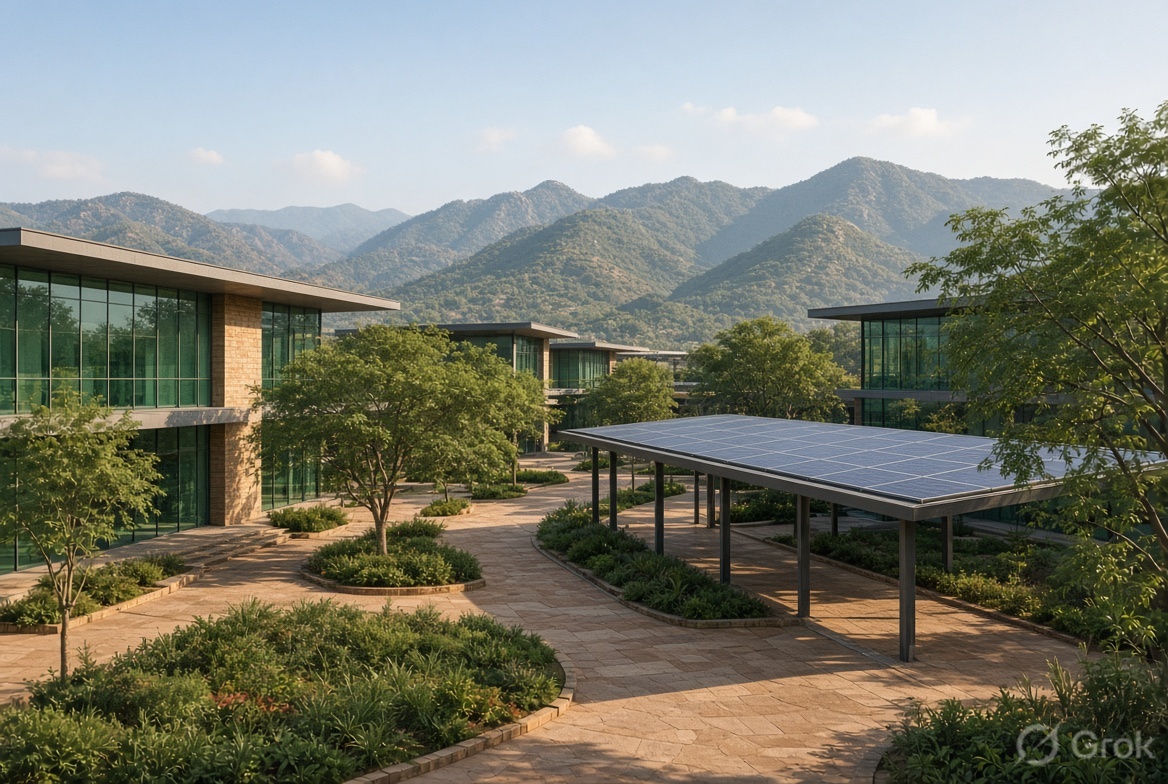 Proposed concept
Emerald Valley: Preparing Neemrana’s Talent for the Global Technology Economy
A proponent's vision — read against what the corridor actually has.
Read the full story
Proposed conceptEmerald Valley: Preparing Neemrana’s Talent for the Global Technology Economy
A proponent's vision — read against what the corridor actually has.
Read the full storyArtist impression · Proposed concept · Not allotted land
Emerald Valley is being envisioned as a forward-looking development initiative that can connect Neemrana’s industrial growth with the opportunities of the global technology economy. Its ambition is not limited to buildings, workplaces or residential development. At its centre is a powerful idea is to prepare a large, industry-ready talent base in India so that international technology companies can find people who are trained, disciplined and ready to contribute from the first day of employment.
The initiative aims to train up to 100,000 students in disciplines and project-based skills aligned with the needs of leading global technology companies, including companies that have helped define Silicon Valley’s culture of innovation. The goal is to create a generation of 'Silicon Valley-ready' professionals from Neemrana and the surrounding region, young people who understand not only classroom theory, but also the tools, workflows, quality standards and practical project methods used by modern technology businesses.
This matters because training is often one of the biggest hidden investments for a company entering a new market. A business may invest in offices, equipment, technology systems, management, recruitment and salaries, but it must also spend time and money preparing new employees for its own work processes. New recruits often require induction, technical instruction, project exposure, mentoring and supervised experience before they can work independently.
Emerald Valley’s training vision seeks to reduce that gap. By developing students through discipline-focused learning and real project exposure, it can help companies access a workforce that is closer to being employment-ready. A technology company evaluating Neemrana would not have to begin by building every element of a basic training pipeline. Instead, it could recruit from a pool of candidates who have already been prepared in relevant skills, professional communication, teamwork, digital tools and project execution.
The commercial value of this model is clear. Reduced onboarding time can lower the cost of building teams. Faster deployment can help companies begin projects earlier. Better-prepared candidates can support stronger productivity and reduce the pressure on senior employees who would otherwise spend substantial time training new recruits. For international companies, this can make the decision to expand in Neemrana more efficient, more predictable and more attractive.
The vision also creates a new opportunity for young people from Rajasthan, Delhi-NCR and nearby states. Rather than moving first and hoping to find the right skills later, students can be trained in pathways connected to real industry demand. They can learn through project work, technical disciplines, innovation challenges, internships, mentoring and exposure to international business practices. This can make their transition from education to employment smoother and more confident.
Emerald Valley can therefore become more than a development project. It can be a bridge between education, technology and employment. Its success would help Neemrana evolve from an industrial destination into a knowledge-enabled growth centre, where factories, global businesses, residences, hospitality and skilled talent reinforce one another.
For global technology companies, Emerald Valley offers the prospect of a ready talent ecosystem. For students, it offers a pathway to globally relevant careers. And for Neemrana, it shall present a positive new identity, a place where the next generation is trained not only to seek jobs, but to be ready for the world’s most demanding workplaces.

Briston: A Managed-Residence Address for Neemrana’s Next Growth Phase
Real water/mobility item, separate from the pitch.
Read the full story
Briston: A Managed-Residence Address for Neemrana’s Next Growth Phase
Real water/mobility item, separate from the pitch.
Read the full storyNeemrana’s next chapter is not only about industrial growth, factories and new investment. It is also about creating a more complete business township where senior professionals, expatriate families, corporate teams and investors can live with comfort, service and confidence. Briston, an upcoming managed-residences project, is being conceived as part of this transformation-a professionally operated residential and hospitality destination designed for the needs of an increasingly international industrial corridor.
Briston is in discussions with leading hospitality and serviced-residence operators, including the Taj Group and Singapore-headquartered CapitaLand for brands such as Ascott and Citadines. Any final brand partnership and operating arrangement will be confirmed after formal agreements are concluded. The larger vision, however, is clear. Briston aims to bring a five-star managed-residence experience to Neemrana, combining private homes with the service standards, maintenance discipline and guest experience associated with premium hospitality.
A managed residence is different from an ordinary apartment. While residents may own or lease their homes, the day-to-day environment is overseen by a professional operator. The project can offer a staffed reception and concierge, housekeeping, linen and laundry support, 24-hour security, visitor management, engineering maintenance, room service, in-residence dining and a dedicated team for property operations. For residents, this means the convenience of a hotel combined with the space, privacy and comfort of a home.
The model is especially suited to Neemrana’s growing industrial base. Japanese, Korean and other international companies need more than factory sites and warehouses; they need reliable homes for senior executives, plant leaders, engineers, consultants, auditors, technical specialists and visiting delegations. A corporate professional arriving for a six-month plant assignment can move into a serviced residence rather than spending time arranging domestic help, repairs, food, transport and local support. Families can benefit from professionally maintained common areas, responsive service teams, controlled access and a more organised community environment.
Briston can offer studio residences for individual professionals, one- and two-bedroom suites for managers and long-stay visitors, larger homes for expatriate families, corporate-serviced units for companies and guest suites for visiting teams. The flexibility of managed residences allows companies to use the project for short stays, monthly assignments, long-term leases or corporate housing programmes, subject to the final operating plan.
Food will be a central part of Briston’s hospitality proposition. Planned Japanese, Korean, Asian and multicuisine restaurants, including concepts such as Haru and My Asiana, can create familiar and high-quality dining choices for residents and business visitors. Japanese and Korean executives can host colleagues and suppliers in a comfortable setting, while local families and professionals gain access to a more diverse dining culture. Restaurants, cafés, private dining rooms, business lunches, catering and in-residence dining can make Briston a natural meeting point for the wider Neemrana business community.
Its clubhouse can become the social and professional heart of the project, with facilities such as a fitness centre, swimming pool, wellness spaces, business lounge, meeting rooms, indoor recreation, children’s areas, event spaces and private dining. A professionally managed club can host corporate gatherings, training sessions, supplier meetings, cultural celebrations and family events close to the industrial corridor.
For Neemrana, Briston represents the lifestyle infrastructure that supports investment. It can create hospitality, maintenance, food-service, security, wellness, transport and event-management jobs while making the town more attractive to companies sending talent from India, Japan, Korea and beyond. A factory may bring an investor to Neemrana; a well-managed home, trusted service, good food and a lively community can encourage people to stay and build their future here.