
Tokai Rika Minda is building the part of the car the driver touches.
Third plant (~JPY 10bn) tracks to Sep 2026 completion.
Read the full story
Tokai Rika Minda is building the part of the car the driver touches.
Third plant (~JPY 10bn) tracks to Sep 2026 completion.
Read the full storyOn 22 February 2023 Uno Minda and Tokai Rika of Japan broke ground on a second plant for their joint venture, Tokai Rika Minda India, in the RIICO industrial area at Neemrana. The company put the site at 20 acres and the capital spend at Rs.200 crore, to expand smart systems and seat belts. Construction was planned to finish by the middle of 2025. The joint venture already makes transmission levers, electric steering-wheel locks, sensors and circuit boards. The new shed was framed as a place to make more of that cabin technology in India.
In August 2024 Uno Minda told the stock exchange that Tokai Rika Minda had opened a manufacturing plant at Neemrana with a stated capacity of 384,022 units a month. The filing named smart keys, shift-by-wire levers, seat belts and other products for later expansion.
That product list is the next layer of the Japanese Zone. Neemrana already stamps, moulds and machines parts. A smart key, a seat belt and a shift lever sit closer to the driver. They carry electronics, a safety standard and a test bench. A plant that makes them pulls in plastic moulding, metal stampings, electronics assembly, fixtures, packaging and tooling from suppliers who can hold a Japanese quality file.
The corridor gains a cabin business beside its motor and component plants. Technical apprentices learn switches, sensing and access systems. Precision workshops on the same road get a buyer who needs more than a simple pressing. Tokai Rika Minda’s Neemrana expansion puts automotive electronics, safety parts and a training ladder into a zone that already knows how to run a Japanese line.

Every time a door opens, a hidden system does the work. That system can be made on this highway.
The live deadline, explained.
Read the full story
Every time a door opens, a hidden system does the work. That system can be made on this highway.
The live deadline, explained.
Read the full storyHi-Lex ACT describes itself as a specialist in door-related automotive equipment, with planning, development and manufacturing kept in house. Its range runs from side-door latches, a high-strength part that holds the door to the body, to check links, hinges and back-door latches. It also builds power sliding-door systems and power back-door systems, the kind that open at a steady speed and reverse if they meet an obstacle. The company calls itself a pioneer of door motorisation in Japan, with power sliding doors from the 1980s and power back doors from the early 2000s.
That is the invisible layer of a car. A latch. A cable. A window regulator. A motor and a control unit for a sliding door or a tailgate. Indian vehicles are adding central locking, powered windows and safer access. The parts stay out of sight. The plant that makes them sits inside every door the owner uses.
Neemrana already runs Japanese lines for motors, switches and cabin parts. A door-systems factory belongs in that sequence. Tooling, cable, moulding, electronics assembly and quality testing are the local trades a latch and a regulator need. Apprentices learn a mechanism that a driver meets every morning. Women on the assembly bench fit a safety part that has to hold.
Hi-Lex offers this corridor a route into the cabin’s moving edge. Mechanical doors on one bench. Electronic access on the next. Neemrana, already a Japanese component town, can be the place those systems are built.

The part the driver never sees starts as a resin.
Effluent-treatment headroom checked as units grow.
Read the full story
The part the driver never sees starts as a resin.
Effluent-treatment headroom checked as units grow.
Read the full storyIn November 2007 Mitsui Prime Advanced Composites India, a subsidiary of Mitsui Chemicals, laid the ground for a polypropylene compounding plant in the Japanese Investment Park at Neemrana. RIICO allotted 15 acres in Phase III at Majrakath. The first capacity was set at 15,000 tonnes a year. Operations were targeted for the first quarter of 2009. The resin was meant for bumpers, panels and pillars on four-wheelers, supplied to car makers across the country. A German trade note put the spend at about 7.6 million dollars and described an 80:20 venture with Prime Polymer, with the foundation stone on 13 November 2007.
Compounded polypropylene is the quiet input. A moulder needs a grade that holds a shape, takes a paint and survives heat in a cabin. Trim, housings and engineering parts on the Neemrana lines begin in a hopper like this one. The finished key, the seat belt and the door latch get the headlines. The resin plant feeds the presses that make them.
That is the supplier economy under the brands. A materials yard on 15 acres supports every auto shop that needs a precise plastic. The same plant is a natural partner for cleaner manufacturing. Recycled content, tighter grades and a stewardship file for scrap from the Zone can grow from a compounder that already sits among the factories.

JTEKT is adding an eighth India plant. The north Indian chain already runs beside this highway.
51 companies (Embassy/JETRO, Oct 2024) — a voluntary survey.
Read the full story
JTEKT is adding an eighth India plant. The north Indian chain already runs beside this highway.
51 companies (Embassy/JETRO, Oct 2024) — a voluntary survey.
Read the full storyOn 8 October 2024 JTEKT Corporation said JTEKT India would build a new factory at Jalisana in Ahmedabad district, Gujarat. The company called it the eighth plant. Investment was set at ₹2,500 million. The site is 118,484 square metres, with a building of 24,900 square metres and 600 people planned. Production is scheduled for 2027. The parts named are column-type electric power steering, manual steering gear, constant-velocity joints and hub-unit bearings. JTEKT India, set up in 1984, listed seven bases at the time of the note. A headquarters and Gurugram factory, three at Dharuhera, one at Chennai, and two at Bawal.
Bawal sits on the same industrial ribbon as Neemrana. Steering columns, gears, joints and bearings are the precision layer of a car. Electric power steering adds electronics to a mechanical trade the Japanese suppliers on this road already know. A Gujarat shed for 2027 is new capacity for a growing Indian market. The Dharuhera and Bawal yards are the existing north Indian base that new work can draw on.
Neemrana’s Japanese Zone is built for that neighbourhood. Machining, test fixtures, electronics assembly and a vendor park for steering parts fit plants that already stamp and mould for the cabin. Warehousing and technical service for a Bawal line can sit a short drive down NH-48. JTEKT’s India growth shows why this corridor stays in Japan’s auto-parts map. The next steering electronics, the next test bench and the next apprentice class have a customer on the same highway. say so rather than reach for a round figure.
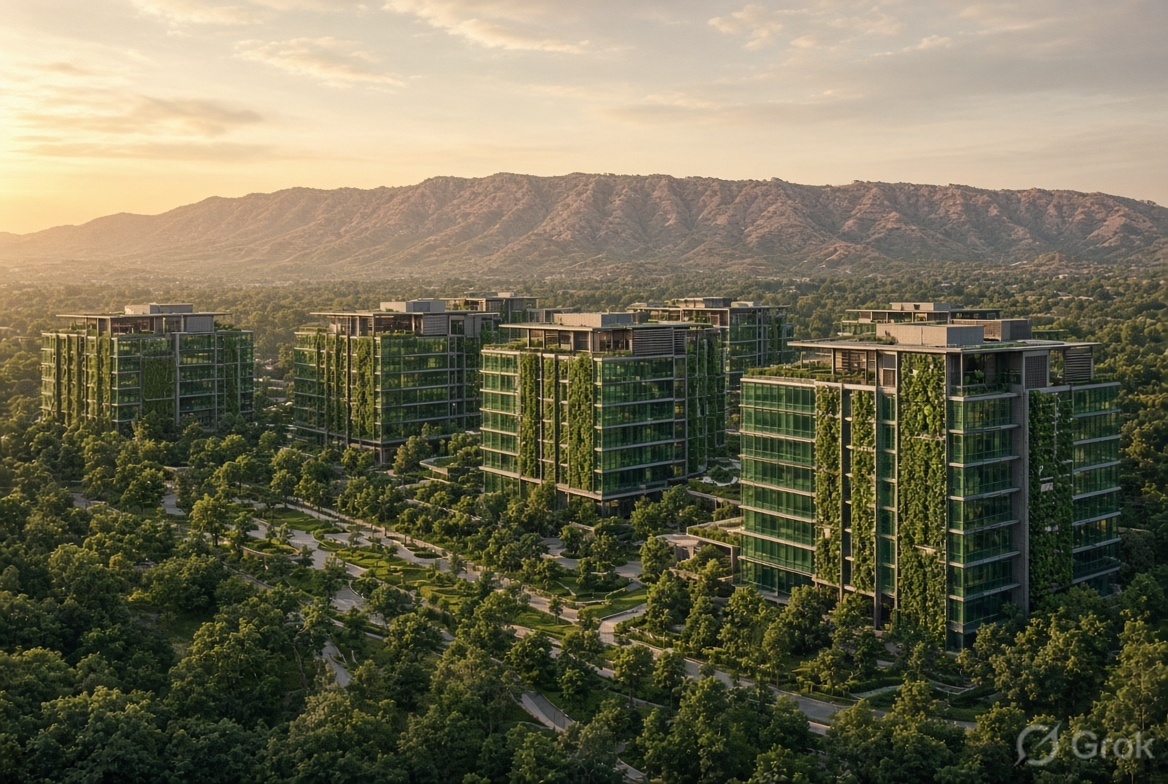 Proposed concept
Emerald Valley is the next layer of a factory town. Homes, shade, skills and a cleaner day
A proponent's vision — read against what the corridor actually has.
Read the full story
Proposed conceptEmerald Valley is the next layer of a factory town. Homes, shade, skills and a cleaner day
A proponent's vision — read against what the corridor actually has.
Read the full storyArtist impression · Proposed concept · Not allotted land
The Emerald Valley is the social and environmental face of a corridor that already makes motors, resins, switches and cabin parts. Factories keep people for a shift. A township keeps them for a life. Housing, green ground, technical training, cleaner growth and a food culture are how Neemrana holds the investment it has already won.
The platform can be drawn around what a hot industrial edge needs. Green landscaping and shade on the walk to work. Water-sensitive streets that catch rain and reuse what the plants clean. Apprenticeship yards tied to the Japanese lines. Buildings that use less power. Digital utilities a facility manager can read. Room for electric vehicles at the gate and at the home. A cleaner edge between the shed and the street, so the township and the factory share one standard.
Daikin’s manufacturing institute on this road already shows what a Japanese plant can teach. Skills, discipline and a campus that treats the ground with care. Emerald Valley can take that benchmark into a wider place. Training in the morning. A shaded street at noon. A kitchen and a common table after the shift. Technical students who prototype heat, water and waste for the factories next door.
Neemrana’s identity has been the Japanese Zone. The next identity is the town around it. Emerald Valley is how that town can be shaped. Green, skilled and lived in, beside the plants that made the highway worth building.

A plant posting lasts longer when the town can host a meal
Real water/mobility item, separate from the pitch.
Read the full story
A plant posting lasts longer when the town can host a meal
Real water/mobility item, separate from the pitch.
Read the full storyBriston presents a hospitality layer beside its Neemrana residence, with planned restaurant brands including Haru and My Asiana, and room in the idea for pan-Asian, Korean, Japanese and multicuisine tables. Those names are company plans. They matter as business infrastructure. A Japanese or Korean stays when the family can eat, when a visitor can be hosted, and when a Friday night feels like a town rather than a highway stop.
The first formats that serve this corridor are practical. A Japanese casual table. A Korean barbecue. A pan-Asian café. A bakery for the morning shift of visitors. A business dining room for a plant meeting. A family table for a weekend. Haru and My Asiana can be set for resident families, for executives at the Zone, and for delegations that arrive for a day and need a room that already knows the menu.
Food is how an industrial corridor becomes a place people accept a posting. Corporate hosting, talent retention and the first week of a new family all run through a kitchen. A food-and-services cluster at Briston, with language on the menu and a table that works on a Tuesday, helps Korean and Japanese investors feel operationally at home from day one.
Neemrana’s factories already supply the reason to be here. A serious dining street supplies the reason to stay. Briston’s hospitality layer is that street, planned as part of the township, and ready to be reported as the town’s next business service.