Neemrana's second economy is ready for the world
Third plant (~JPY 10bn) tracks to Sep 2026 completion.
Read the full story
Neemrana's second economy is ready for the world
Third plant (~JPY 10bn) tracks to Sep 2026 completion.
Read the full storyMost investors know Neemrana for its factories, and they are the town's first economy. Neemrana also has a second economy, one of heritage, hospitality, celebrations and food. World Tourism Day on 27 September is a good moment to look at it properly.
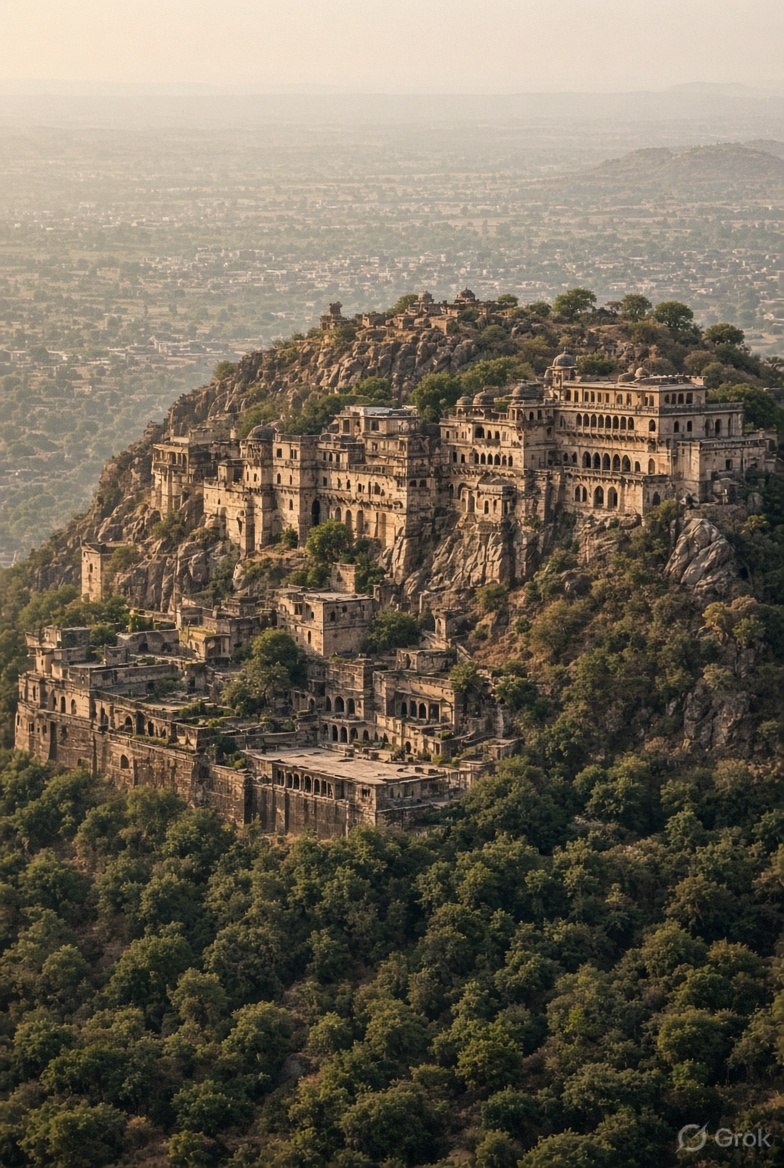
Its centrepiece is the 15th century Neemrana Fort Palace, which sits above the Delhi Jaipur highway. It is now one of India's best known heritage hotels. Around it has grown a wider hospitality market. Travel platforms now list 44 hotels in Neemrana, including heritage resorts, business hotels and budget stays. For a town of its size, that is a remarkable number of places to stay.
The visitors are just as varied. Weekend travellers drive in from Delhi NCR. Wedding parties book entire properties. Factory teams arrive for audits and installations, and Japanese and Korean executives come for board meetings. Highway travellers stop for a meal between Delhi and Jaipur. Together they support dhabas, restaurants, drivers, decorators, caterers and craft sellers, work that exists because Neemrana is easy to reach.
The timing suits the wider state. Rajasthan has about ₹3,000 crore of tourism projects moving into construction. A growing share of the new hotels coming up are aimed at the mass premium and mid market segments. That is the kind of well run, business friendly property Neemrana's mix of industrial and leisure visitors needs.
This year's World Tourism Day also looks ahead, with a focus on digital transformation and AI in tourism. That points to Neemrana's next opportunity. The town can make every visit easy to plan as well as welcoming.
Consider a Japanese engineer planning a trip from Osaka. Today the trip can take a dozen emails. They go to the hotel, a driver, an interpreter, the factory and a restaurant. Now imagine a Neemrana Signal AI assistant doing it all in one conversation. It would book a business hotel near the Japanese Zone and arrange airport pickup from Delhi. It would find a Japanese speaking guide, reserve dinner at a Japanese restaurant and suggest a sunset visit to the fort once the meetings are done. The same assistant could plan a wedding weekend, a corporate retreat or a student industrial tour.
This is also a business opportunity. Every hotel, driver, guide and restaurant that joins such a platform would reach visitors who might never have found them. Every visitor who has an easy trip is more likely to come back and to bring colleagues.
Neemrana's factories have made it known to the business world. Its second economy can make it a place people remember and return to.

Rajasthan's new AI rulebook opens a door for Neemrana
Supplementary DPR and funding under Rajasthan review.
Read the full story
Rajasthan's new AI rulebook opens a door for Neemrana
Supplementary DPR and funding under Rajasthan review.
Read the full storyArtificial intelligence needs a great deal of electricity, and computing that runs on the sun needs somewhere sunny to be built. Rajasthan has plenty of sun and has now written policies designed to attract AI. Neemrana is well placed to benefit.
Two state policies now work together. The Rajasthan Data Centre Policy 2025 aims to make the state a national data centre hub and attract ₹20,000 crore of investment within five years. The Rajasthan AI/ML Policy 2026 describes itself as a force multiplier. It adds extra incentives on top of those already offered under RIPS 2024, the MSME Policy 2024, the Data Centre Policy 2025 and the Startup Policy 2022.
The data centre package is generous. It includes an annual asset creation incentive of ₹10 to 20 crore for ten years. The first three data centres that invest more than ₹100 crore receive an extra 25 percent sunrise incentive. Operators also get a 5 percent interest subsidy for five years, along with exemptions on stamp duty, land conversion and electricity charges and guarantees of uninterrupted power. The AI policy then adds a further 1 percent interest subvention for AI data centres and makes AI industries eligible for sunrise sector benefits under RIPS 2024.
The green element is the most striking. The data centre policy fully exempts banking, transmission and wheeling charges, and it reimburses half the cost of adopting green solutions up to ₹12.5 crore. In plain terms, a data centre can buy solar power generated in western Rajasthan and have it delivered to its site without paying the usual network charges. It can also bank surplus daytime power for use later.
Rajasthan has a lot of solar power to offer. It had 44.37 GW of installed solar capacity as of 31 August 2026, the largest of any Indian state. It is targeting 125 GW of renewable capacity by 2029-30, including 90 GW of solar and 10 GW of hydro, pumped storage and battery storage. Closer to Neemrana, the Alwar district already has 36 operational solar plants and many more projects under development.
That is where Neemrana fits in. It sits on the Delhi Jaipur corridor, close to NCR's companies and fibre networks. It has industrial land and an established manufacturing base that needs AI for quality inspection, predictive maintenance and energy management. An edge data centre in Neemrana could serve factories next door and customers in Gurugram with low latency, running largely on Rajasthan's sun.
The AI policy also supports the wider ecosystem. It offers AI skilling reimbursements, support for acquiring AI software for MSMEs, and matching state reimbursement of IndiaAI Mission cloud credits for startups. Together these give industrial software firms and young AI companies good reasons to set up close to the factories they serve. [ai.rajasthan.gov]
Rajasthan already supplies much of India's clean power. Neemrana could now help it supply AI computing powered by that clean energy.

Investors are arriving in Neemrana, and the town has rooms waiting
Effluent-treatment headroom checked as units grow.
Read the full story
Investors are arriving in Neemrana, and the town has rooms waiting
Effluent-treatment headroom checked as units grow.
Read the full storyThis week shows how Neemrana is changing. On 25 September KRN Heat Exchanger holds its 9th Annual General Meeting. On 29 and 30 September the company meets analysts and investors, including a physical meeting in Neemrana itself. A listed manufacturer is inviting shareholders to the town where it makes its products.
That is a sign of a maturing corridor. Listed companies based in Neemrana put the town in front of fund managers, analysts and retail shareholders across India. Every quarterly result, investor presentation and AGM notice carries the address of the RIICO Industrial Area in Neemrana. Every plant tour turns an abstract investment into something investors can see. KRN's recent record gives visitors a lot to look at. Its capacity has grown sixfold, it completed a ₹350 crore QIP and its FY26 profit rose 45 percent.
Investors who come to visit will also need somewhere to stay, and Neemrana already has a good range of options.
Travel platforms now list 44 hotels in Neemrana, backed by a growing number of guest reviews. Rooms start from around Rs.5000 a night. The mix covers heritage, business and value. The 15th century Neemrana Fort Palace is one of India's best known heritage hotels. Resorts along the Delhi Jaipur highway, such as the four star Shiva Oasis Resort at Hamjapur, serve weekend guests and business travellers alike. Business hotels and budget stays near the industrial estates cater to engineers, auditors and project
Two groups of guests fill these rooms. On weekdays factory visitors arrive, including supplier teams, installation crews, Japanese and Korean executives and, now, investors. On weekends, families from Delhi NCR, wedding parties and heritage travellers take over. A town that serves both does not depend on one kind of guest, which is a strong basis for a hospitality market.
The two trends feed each other. Growing factories bring more business visitors. More visitors support better hotels. Better hotels make it easier to host investor days, supplier conferences and corporate retreats, and those events bring more capital into the corridor.
For hospitality investors, the next opportunity is clear. As companies such as KRN, Daikin and their suppliers keep expanding, Neemrana will need more business class rooms, meeting spaces and serviced long stay apartments. Developers who build them will have both weekday and weekend demand to draw on.
Neemrana has become a place where companies build, list and meet their investors, and its hotel market is growing to match.

Rajasthan's industrial land goes live for bidding next week
Corridor freight via the DFC terminal.
Read the full story
Rajasthan's industrial land goes live for bidding next week
Corridor freight via the DFC terminal.
Read the full storyThe application window for RIICO's latest e-auction of undeveloped and semi-developed industrial land closes today, 25 September. Online bidding opens on Monday and runs from 28 to 30 September.
This round offers plots in Jaipur, Bhiwadi, Dausa, Kota, Bikaner, Rajsamand and Udaipur. The nearest to the Neemrana corridor is at Rabarka in Bhiwadi. Plots come with a 33 year lease that can be renewed twice. Each renewal is priced at 10 percent of the prevailing allotment rate, so investors can see their land costs well into the future.
What to watch this week
- Bids per plot. Several bidders on the same plot is the clearest sign of demand.
- The premium over reserve price. How far final bids exceed the base price shows how highly investors value each location.
- Bhiwadi versus other districts. How Rabarka performs against plots elsewhere in the state will show how much appetite there is for land close to NCR.
- The Dausa Bandikui logistics hub. Results there will show how strong demand is for warehousing and logistics land along the Delhi Mumbai Expressway.
- Unsold plots. Any plots left over are likely to come back in the next round, which could also bring more corridor locations, including Neemrana and EPIP Neemrana.
Why it matters
Recent rounds suggest demand is strong. RIICO's direct allotment programme drew 954 applications for 242 industrial plots in its 13th phase. If the e-auction draws a similar response, it will confirm steady interest from manufacturers and logistics firms in land across Rajasthan, and especially in the belt connecting Bhiwadi and Neemrana to Delhi NCR.
Neemrana Signal will publish the results as they come in and look at what they suggest for the next round.

Briston is building a home in Neemrana for Japan
Rooms/rates snapshot for visiting teams.
Read the full story
Briston is building a home in Neemrana for Japan
Rooms/rates snapshot for visiting teams.
Read the full storyNeemrana's Japanese story began in the factories. Over almost two decades the town has become home to India's largest cluster of Japanese companies in a single industrial park. That includes 57 Japanese manufacturers and about 30,000 jobs. Japan found a production base in Neemrana. What its people still lacked was a home there.
For years Japanese managers and engineers have told a similar story. They wanted to live near their plants, but the corridor did not have the housing and daily life they were used to. There were few homes designed around Japanese habits, few services that understood them and no community to return to after work. Many chose to live in Gurugram and made the long drive to the factory every morning.
Briston decided to change that. It was already building in Neemrana, and it saw that it could help solve this problem too. It chose to go beyond selling apartments and began creating a Japanese living ecosystem in the heart of the corridor.
The result is Briston's Indo Japanese Inspired Wellness Residences, which the company describes as the new landmark of NCR. More than 400 premium residences are planned. They are designed around the LDK layout that Japanese families know well, combining living, dining and kitchen space. Residents can choose between three layouts, the 1LDK Presidential, the 1LDK Premier and can tour each one online in immersive 360 degree views before they visit.
Everyday comfort is built in. Residents have round the clock CCTV security, a continuous and reliable water supply, power backup and modern fire safety. The development offers more than 50 amenities. It is designed to be smart, green and efficient. That fits the Japanese instinct for harmony between home and nature.
Daily life is also close at hand. The development includes more than 30 retail destinations, Grade A workspaces and commercial units, so shopping, dining, work and leisure can all happen within a short walk of home. For a family arriving from Osaka or Nagoya, it can offer a life that feels familiar from the first week.
The residences are designed for leasing. Japanese and Korean companies can arrange homes for their managers, engineers and families under corporate leases. A company can welcome new staff into ready homes instead of spending weeks searching. The factory is minutes away, not hours, and after work residents return to neighbours from the same culture.
Briston's vision is simple. If Japan is going to keep building in Neemrana, its people should be able to live there comfortably too.
Japanese and Korean companies can contact Briston at info@briston.co.in to discuss corporate leasing for their teams.

Building The Emerald Valley: solar-linked compute
A proponent's vision — read against what the corridor actually has.
Read the full story
Building The Emerald Valley: solar-linked compute
A proponent's vision — read against what the corridor actually has.
Read the full storyA good factory produces a great deal of data. Every weld, coil and compressor leaves a record in sensors, cameras and machine logs. Most of that data is never analysed. Neemrana has one of India's largest clusters of modern factories, so it could become a good place to teach young engineers how to put that data to use.
Rajasthan has created the policy framework to support this. The Rajasthan AI/ML Policy 2026 aims to build AI skills alongside industry and startups. It offers reimbursements for AI skilling and support for MSMEs that adopt AI software. The state has also launched the Rajasthan AI Portal and the iStart Learning Management System to encourage AI-driven education, research and skill development. [ai.rajasthan.gov]
The Emerald Valley vision could turn that framework into a campus. Its presentation proposes a Rajasthan Institute of AI and an AI and Machine Learning Center. It sets out a teaching model built on project-based learning, a curriculum designed with industry partners, internships and practical training.
Picture an Emerald Valley AI academy built around the factories next door.
In the quality inspection lab, students would train computer vision models on images from real production lines. The models would learn to spot a flawed brazing joint or a scratched panel faster than the human eye.
In the predictive maintenance studio, trainees would study vibration, temperature and power data from motors and compressors. They would learn to warn a plant manager days before a machine fails.
In the energy optimisation workshop, engineers would learn to cut a factory's power bill by adjusting cooling, lighting and compressed air use. Much of that work would be powered by Rajasthan's sun.
Students would then take these skills back to the factories. Each cohort would work on live problems set by partner companies, and the best projects would be deployed on the shop floor.
The academy would complement Rajasthan's wider push on skills. Under PM-SETU, the ₹241 crore Bhiwadi ITI cluster, which includes Neemrana ITI, is upgrading technical trades across the region. An AI academy would build on that foundation, so a young technician trained at an ITI could go on to become an industrial AI engineer.
Industry would benefit as much as the students. Manufacturers would gain local talent that already understands their machines. Startups would find their first customers down the road. Global companies would see Neemrana developing the skills that modern manufacturing will need.
Neemrana already has the factories and a large volume of industrial data. The Emerald Valley imagines a place where young people learn to turn that data into better manufacturing.

A weekend in two worlds: Neemrana's heritage and industry
Real water/mobility item, separate from the pitch.
Read the full story
A weekend in two worlds: Neemrana's heritage and industry
Real water/mobility item, separate from the pitch.
Read the full storyMost towns are known for one thing. Neemrana has two. One is a 15th century fort palace above the Delhi Jaipur highway. The other is India's largest cluster of Japanese companies in a single industrial park, where 57 Japanese manufacturers build products for India and beyond. As World Tourism Day falls this weekend, here are two ways to spend a day in Neemrana, one for a family that lives there and one for visitors.
A Japanese family's weekend
Imagine the Tanakas, a family from Nagoya. The father is a production engineer on a three year assignment at a Neemrana plant. The family lives in a Briston residence, one of the Indo Japanese inspired LDK homes being developed in the town.
Saturday begins slowly with brunch on the ramparts of Neemrana Fort Palace. The children explore the terraces while their parents look out over the Aravalli hills. By late morning the family is at a village craft workshop. The children try block printing, and their mother picks out hand woven textiles for the living room.
In the afternoon a local guide leads a food trail through nearby villages. The family tastes fresh bajra roti, seasonal sabzis and sweets made in small kitchens that have served the area for generations. They discover that Rajasthani food, like Japanese food, puts great care into simple ingredients.
On Sunday morning the family goes cycling on quiet rural roads outside town while the air is still cool. That evening they are back at home in their Briston residence, where the familiar 1LDK and 3LDK layouts make an evening of home cooked Japanese food feel natural. Friends from other Japanese families come over, and conversation turns to next weekend's plans.
A day for visitors
The same town can host a very different day. Imagine a group of engineering students, overseas investors or curious travellers on a curated heritage and industry tour.
The morning starts at the fort, with a guided walk through five centuries of Rajasthani history and architecture. After lunch the group drives a few minutes to the Japanese Zone. Partner companies host short factory visits there and explain how precision manufacturing, lean production and quality discipline turn raw materials into cooling systems, auto components and industrial parts.
By evening, visitors have seen Rajasthan's past and India's industrial future in a single day. Industrial tourism is growing worldwide because people want to see how things are made. Few places offer that alongside a fort palace.
Why it matters
A town that offers a good weekend is easier to live in. Families who enjoy their weekends are more likely to stay longer, and satisfied companies are more likely to expand. Visitors who see Neemrana's factories and heritage in person tend to become its best advocates.