Rajasthan’s hotel money is moving mid-market to Neemrana’s weekday
Third plant (~JPY 10bn) tracks to Sep 2026 completion.
Read the full story
Rajasthan’s hotel money is moving mid-market to Neemrana’s weekday
Third plant (~JPY 10bn) tracks to Sep 2026 completion.
Read the full storySignal reports that about ₹3,000 crore of tourism projects, across some 40 schemes, have moved into execution. The same piece put mass-premium and mid-market hotels at an estimated 45 per cent of Rajasthan’s branded pipeline for FY26 to FY30, against 25 per cent upper-upscale, 20 per cent luxury and 10 per cent budget. The state is expected to add 12,000 to 15,000 branded rooms by FY30, with nearly 60 per cent of that stock outside Jaipur, Udaipur and Jodhpur. Rising Rajasthan tourism MoUs were restated at about ₹1.38 lakh crore.
Jaipur is already taking the large lawns. FHTR has spoken of more than 40 big properties around the Pink City, including a block on the Delhi highway. IHG has signed an InterContinental resort at Achrol on that same road for early 2030. Wedding and leisure capital is clustering there.
Neemrana’s hospitality job is upcoming boom for the mid-market and where it is becoming a weekend and holiday market. The Neemrana fort-palace already is there. Factory auditors, Japanese and Indian plant staff, and overflow wedding parties need clean mid-market rooms, a hall for forty and a kitchen that works on a Tuesday. Long-stay professionals need a week-rate, not a palace tariff. That is mass-premium in the industrial sense. Heritage is the backdrop.
Neemrana luxury hotel rooms touch Rs20000 per night on peak days leave along Neemrana Fort which becomes hot market on weekends with Japanese and Korean industrial guests the Neemrana has an appetite for at least five luxury five star hotels. Also a well-designed 80-to-150 key house, or a serviced block with meeting rooms, fits that demand more closely than another ultra-luxury lawn. Water, power and a published weekday rate decide whether the house runs.

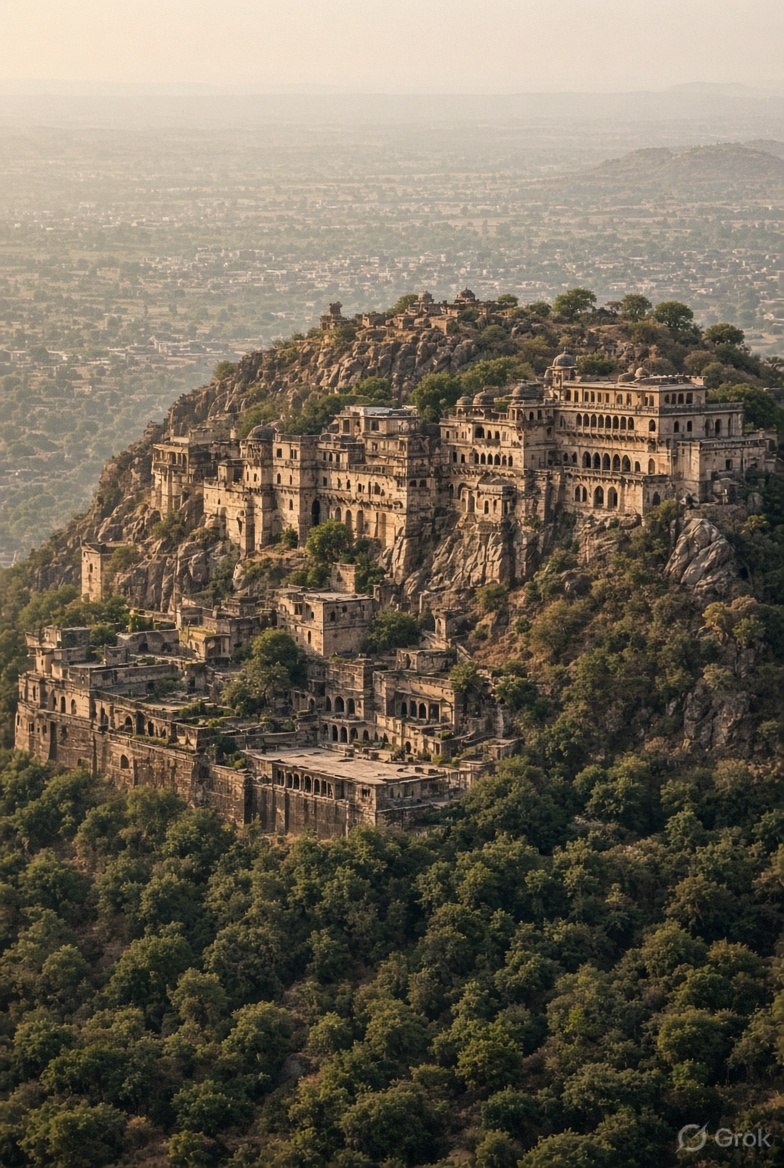
Neemrana already holds two frames a camera wants. Heritage on the hill. Industry on the highway.
Effluent-treatment headroom checked as units grow.
Read the full story
Neemrana already holds two frames a camera wants. Heritage on the hill. Industry on the highway.
Effluent-treatment headroom checked as units grow.
Read the full storyIndia Cine Hub, run by the Ministry of Information and Broadcasting through NFDC, now offers a single digital window for filming permissions, coordination and, for foreign crews, the path toward a film visa. Rajasthan continues to sell itself as a location state, with incentives and tourism infrastructure behind the pitch.
The Fort-Palace gives courtyards, terraces and a skyline that reads as old Rajasthan. Below it, the Japanese Zone and the Indian sheds give a second grammar. Clean factory lines, night-shift light, trucks on NH-48, the edge of the Aravallis. Fort and plant in one drive is rare. Brand films, corporate films, documentaries and destination campaigns look for that contrast.
The weekday city supplies the rest of a small shoot. Highway rooms. A kitchen that can feed a unit. Power and parking for a generator. Jaipur’s larger crew base is close enough for a two-day call. Factory visits, when a plant agrees, turn an industrial town into a living backdrop rather than a painted one.
The emerald valley background of the natural Neemrana gives enough for an ideal film shooting during winters and indoors during summers. Someone has to move the pitch that far. Signal has already made a beginning.

Namo Bharat moves closer to Neemrana as groundwork begins
Corridor freight via the DFC terminal.
Read the full story
Namo Bharat moves closer to Neemrana as groundwork begins
Corridor freight via the DFC terminal.
Read the full storyNeemrana's link to Delhi's regional rail network is getting closer. The planned Namo Bharat corridor into the SNB region has cleared important planning stages, and the groundwork for building it has already started.
In July 2026 the Public Investment Board approved the 36 kilometre extension of the Delhi Gurugram Bawal RRTS project to Behror. That brings the corridor well past Haryana and into Rajasthan's industrial heartland.
Rajasthan is now moving quickly on its part. On 2 September Chief Secretary V Srinivas reviewed the supplementary Detailed Project Report for the Bawal Behror section. He told departments to work together, get approval from the competent authorities and send the state's in principle approval to the Union Ministry of Housing and Urban Affairs as soon as possible.
The plan itself is well defined. The corridor from Sarai Kale Khan to Behror will run 129.05 kilometres, and 25.16 kilometres of that will be in Rajasthan. Four elevated stations are proposed at Shahjahanpur Neemrana Behror, Shahjahanpur, Neemrana and Behror. The Bawal Behror section is costed at Rs 7,747 crore. That figure includes about Rs 640 crore for land, which shows the land needed for the route has been identified and budgeted within the project plan.
The builder is also getting ready. NCRTC, the agency behind the Delhi Meerut Namo Bharat line, says the Delhi SNB Alwar corridor is at an advanced stage of consideration. Geotechnical surveys, utility mapping and the shifting of power lines and water pipelines have already started, so that work can move faster once the remaining approvals come through. NCRTC's leadership says the new corridors are in the final stages of approval from the Centre.
This matters because NCRTC has done it before. It finished the 82 kilometre Delhi Meerut corridor, which now serves 16 stations, and brought fast regional rail to the NCR.
For Neemrana, Namo Bharat is about more than commuting. It can bring Japanese and Korean executives, supplier teams, engineers and young professionals within easy reach of Delhi NCR. It can make one day business visits practical, widen the talent pool for factories and create new demand around the stations for serviced residences, business hotels, offices, retail and training centres.
Investors who start planning around the four Rajasthan stations now will be ready when construction begins.
 Proposed concept
Invest Neemrana builds a digital front door for industry in the SNB corridor
Rooms/rates snapshot for visiting teams.
Read the full story
Proposed conceptInvest Neemrana builds a digital front door for industry in the SNB corridor
Rooms/rates snapshot for visiting teams.
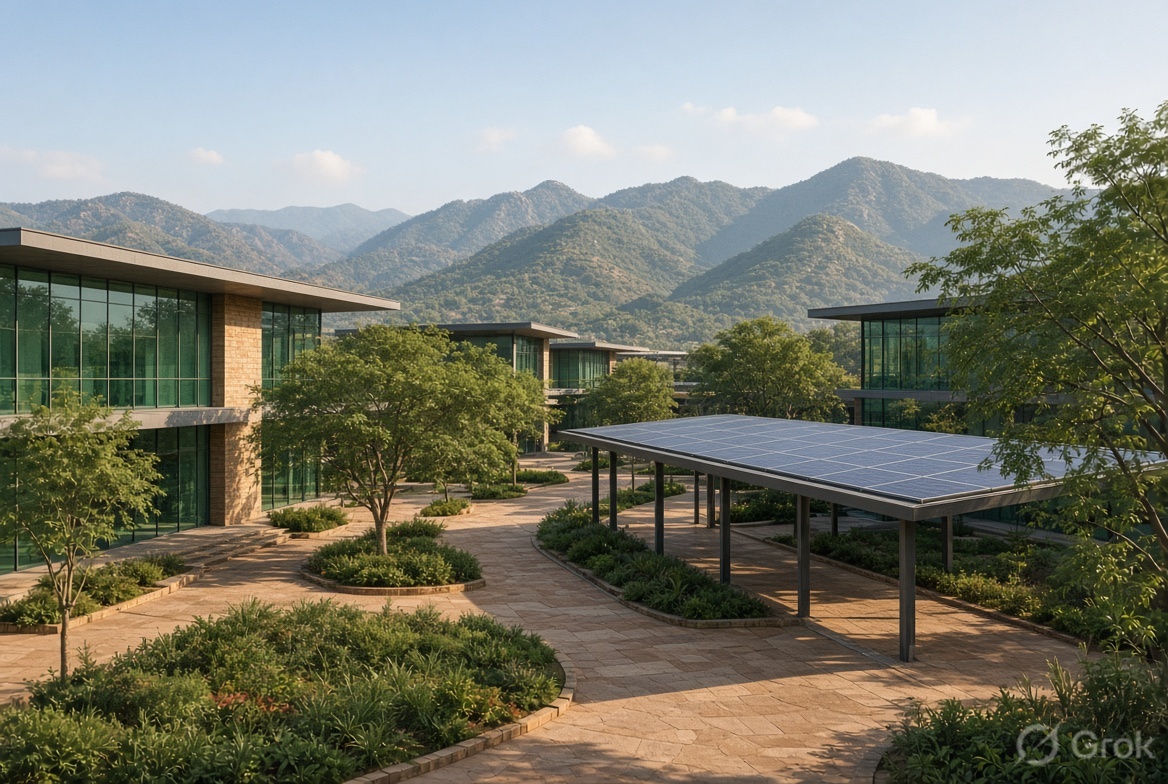
Read the full storyArtist impression · Proposed concept · Not allotted land
Neemrana's rise as an industrial corridor has produced factories, suppliers, jobs and global partnerships. It now also has a digital platform built to help the next wave of investors understand the region and act with confidence.
Invest Neemrana is as independent intelligence for investors, manufacturers, MSMEs and global partners exploring Neemrana, the SNB corridor and Rajasthan's gateway to the Delhi Mumbai industrial economy. It aims to be more than a promotional website. It is designed to be a working guide to one of India's most internationally recognised manufacturing addresses. [investneemrana](https://investneemrana.in/)
The platform starts with the corridor's strongest asset, its operating industrial base. It highlights the RIICO Japanese Zone, which spans about 1,166 acres, and profiles a manufacturing community that includes Daikin, Nidec, Tokai Rika Minda, Nissin Brake, Hitachi Astemo, Mikuni, Toyoda Gosei and many other Japanese companies. For an overseas executive or an Indian supplier, that gives an immediate picture of a mature, supplier rich ecosystem.
The site is organised around what a visitor wants to do. Investors can explore routes to build a factory, expand a business, find industrial land, study green compute opportunities, enter tourism and hospitality, or understand incentives and approvals. Separate tracks serve investors, logistics firms, students, agri entrepreneurs, sustainability leaders and researchers. That reflects a simple truth. A successful industrial region is built by many kinds of participants, not only by large factories.
Its most useful feature is its commitment to clarity. Invest Neemrana separates operating assets, planned developments, policy supported opportunities and future concepts. Its live status panel tracks the Rajasthan Investment Promotion Scheme 2024, RIICO land auctions, RRTS progress, Japanese industry and the SNB 2041 Master Plan. For global companies that need dependable information before committing capital, that transparency is a competitive advantage.
The platform also looks to the future. Its Emerald Futures section gives a dedicated space to new concepts, including The Emerald Valley, and invites partners who want to help shape Neemrana's next chapter in technology, clean energy and sustainable urban growth.
Its daily publication, Neemrana Signal, adds a regular stream of stories on industry, infrastructure, housing, hospitality, skills and sustainability.
Neemrana has already proved that global manufacturers can thrive in Rajasthan. Invest Neemrana is built to make the next decision easier. It brings the corridor's opportunities, policies, land routes and future vision together in one place.
Invest Neemrana Investor Desk. A guided enquiry service that takes companies from first interest to site visits, partner introductions and a clear route to production.

The Emerald Valley, a green technology city vision for Rajasthan
A proponent's vision — read against what the corridor actually has.
Read the full story
The Emerald Valley, a green technology city vision for Rajasthan
A proponent's vision — read against what the corridor actually has.
Read the full storyRajasthan is known for its colour-coded cities. Jaipur is pink and Jodhpur is blue. The Emerald Valley shall be adding a green one, a city built around technology, learning and sustainability.
The Emerald Valley is a proposed technology and innovation city in Rajasthan, set out as a development vision of its founder. The concept spans 3,000 acres. The first 1,500 acres would host technology zones, universities, homes and recreation, and the remaining land would be kept for future growth and more green space. It is designed as a zero waste, zero emission, circular economy city.
Green is the organising idea throughout. The vision describes Emerald Towers with deep green glass facades for business, Sage Residences with calm green exteriors for living, and large public parks meant to support biodiversity. For every 100 acres developed, 30 acres would be set aside as forest. Vertical gardens, rooftop greenery and solar powered walkways would help cool the city and lower its energy use.
Learning is at the centre of the plan. The vision includes technology universities and institutes focused on artificial intelligence, green technology, cybersecurity and biotechnology. It also proposes partnerships with leading global universities and training built around real industry projects. Its target is to develop a skilled technology workforce of up to 100,000 professionals, working closely with companies.
The city is also planned as a place for companies and new ideas to grow. The concept includes innovation hubs, startup incubators, accelerator partnerships with established companies and labs where young firms can test their technology with larger partners. Solar generation, grid scale storage, water reclamation and AI assisted recycling would support its sustainability goals.
The Emerald Valley does not leave Rajasthan's identity behind. Its residential areas are planned as smart villages that combine modern design with traditional Rajasthani architecture. Its cultural centres would bring the state's art, music, crafts and cuisine together with new digital forms of storytelling.
For Neemrana, the vision points to a natural next step. The corridor already has one of India's strongest manufacturing ecosystems. A green technology city nearby could add research, software, clean energy and skills, which are the capabilities modern factories increasingly need. It could turn industrial strength into innovation.
The Emerald Valley starts with a simple ambition. It wants to show that Rajasthan can build a future that is technologically advanced, environmentally responsible and rooted in its own culture.
Commercial opportunity
Emerald Valley Partnership Brief. It would be written for universities, technology companies, clean energy firms and institutions that want to help shape the first phase.
Disclosure
The Emerald Valley is a founder associated development vision and is not an investment solicitation.

Briston brings a Japanese way of living to Neemrana
Real water/mobility item, separate from the pitch.
Read the full story
Briston brings a Japanese way of living to Neemrana
Real water/mobility item, separate from the pitch.
Read the full storyFor almost two decades Neemrana has welcomed Japanese industry. Now a Neemrana developer wants to give the corridor's Japanese and Korean professionals homes that suit them.
Briston is building what it calls Indo Japanese inspired wellness residences in Neemrana. It plans to lease them to Japanese companies for their managers, engineers and visiting specialists. The idea answers a question the corridor's growth has raised for years. Neemrana makes things for the world, so where should the people who run its factories live?
The industrial base is large. JETRO has described Neemrana's Japanese Industrial Township as India's largest concentration of Japanese companies in a single industrial park. It counts 57 Japanese manufacturers and about 30,000 employment opportunities. Housing has not grown at the same pace. Briston estimates that Japanese and Korean professionals in the corridor need about 10,000 more homes. Many of them live in Gurugram or other cities and commute long distances to work.
Briston's answer is to create a Japanese living ecosystem close to the factories. Its residences use the LDK format familiar to Japanese families. That means a living, dining and kitchen space, available in 1LDK Presidential, 1LDK Premier and 3LDK Premier layouts. Prospective residents can explore them through immersive 360 degree virtual tours. The homes come with round the clock CCTV security, continuous water supply, power backup and modern fire safety systems.
The design also borrows from Japan's ecological tradition. Briston plans to plant Miyawaki style forests. This Japanese method uses dense planting of native species to create green spaces that grow quickly. For residents, it means shade, cleaner air and a calm place at home. For Neemrana, it adds to a greener and more liveable corridor.
Briston's ambition goes well beyond one building. It plans to scale up to about 10,000 residences for Japanese and Korean professionals, so that more of the corridor's global workforce can live near where it works.
The wider economic effect could be large. Homes close to factories cut commuting time, help companies attract and keep senior talent, and make relocation easier for families. They also create local jobs in property management, housekeeping, maintenance, transport, food and hospitality.
If Neemrana gives its Japanese and Korean professionals a real place to call home, it becomes easier for more global companies to choose it.
The commercial opportunity is that Neemrana Japanese Korean Corporate Housing Index. This would track corporate lease demand, resident services and the growth of the international living economy across the SNB corridor.
Disclosure
Briston is an emerging international residential proposition. Specific project features, delivery timelines and commercial details should be confirmed through the company's official information at https://briston.co.in