
Jaipur Capital takes over Global Ceramics’ Neemrana sanitaryware plant
Third plant (~JPY 10bn) tracks to Sep 2026 completion.
Read the full story
Jaipur Capital takes over Global Ceramics’ Neemrana sanitaryware plant
Third plant (~JPY 10bn) tracks to Sep 2026 completion.
Read the full storyJaipur Capital has bought the manufacturing business and selected assets of Global Ceramics Private Limited. The deal is structured as an asset transfer. Production will be run by Melozzo Living Limited, the group’s bathroom and home-solutions company.
The factory is in Neemrana. The buyer says the campus covers about 20 acres, with roughly 900,000 square feet of built-up space and sanitaryware machinery already in place. Stated capacity is about 62 metric tonnes, with scope to lift that to about 124 metric tonnes if the line is expanded. Vikas Johari, a director at Jaipur Capital, called the site an established manufacturing platform and said the firm would sell in India and in selected overseas markets.
The purchase puts a building-materials plant into a corridor better known for automotive and engineering units. It also shows how capital is moving into existing industrial assets rather than only into new sheds. Melozzo now has to run the inherited works, raise utilisation if it can, and turn the stated export interest in Southeast Asia, the Middle East and Africa into actual orders.

Sterling & Wilson wins 534.3 MWp solar job in Rajasthan
Supplementary DPR and funding under Rajasthan review.
Read the full story
Sterling & Wilson wins 534.3 MWp solar job in Rajasthan
Supplementary DPR and funding under Rajasthan review.
Read the full storySterling & Wilson Renewable Energy has booked a 534.3 MWp solar order in Rajasthan from an unnamed Indian independent power producer. The same 22 September disclosure paired that contract with two battery-storage jobs in South Africa. Combined value, including tax, was put at more than ₹985 crore. The Rajasthan award is an engineering and construction contract.
The order adds to a state pipeline that already includes large desert parks and recent battery commissioning in Bikaner. Rajasthan remains one of India’s main solar-build geographies. That scale matters for industry only where factories can actually buy the electrons.
For Neemrana the relevant question is procurement, not the megawatt figure on a western-Rajasthan site. Plants can add rooftop arrays, seek open-access or group-captive supply, and install meters and efficient motors against a rising grid and diesel bill. Hotels and any new campus face the same choice. A state EPC win does not, by itself, cut a factory’s tariff or charge a fleet of vehicles on NH-48.
The competitiveness case is therefore local. Secure a dated connection. Price rooftop and wheeled renewable power against current DISCOM rates. Treat storage as ride-through for trips, not as a desert park transplanted to the Japanese Zone. The Sterling & Wilson contract shows Rajasthan is still winning utility-scale solar work. Neemrana’s factories will use that market only if they sign their own power papers.
Rajasthan’s test is no longer the size of the MoU pile
The live deadline, explained.
Read the full story
Rajasthan’s test is no longer the size of the MoU pile
The live deadline, explained.
Read the full storyAt the NITI Aayog governing council in June 2026, Chief Minister Bhajan Lal Sharma said Rajasthan had signed investment MoUs worth Rs,35 lakh crore and that proposals of more than Rs.9 lakh crore had reached groundbreaking. A NITI-linked readout repeated those figures and a $350 billion economy target for 2029. In late July the Chief Secretary’s office gave a narrower summit tally. More than 11,000 active MoUs still added up to over Rs,35 lakh crore, officials said, but projects already “grounded” from the Rising Rajasthan event were put above Rs,8 lakh crore, with a push to meet further grounding targets by November. The numbers move with the briefing. The policy shift does not. Jaipur is now judged on delivery, not on the next signing ceremony.
That is a harder story. An MoU when grounded becomes execution is land, a power bay, water, a road, an NOC and a contractor who pours concrete. Additional Chief Secretary Shikhar Agrawal told the July review that departments were chasing allotments, statutory clearances and letters of intent. Those are the bottlenecks that decide whether a Rs,35 lakh crore headline becomes a plant.
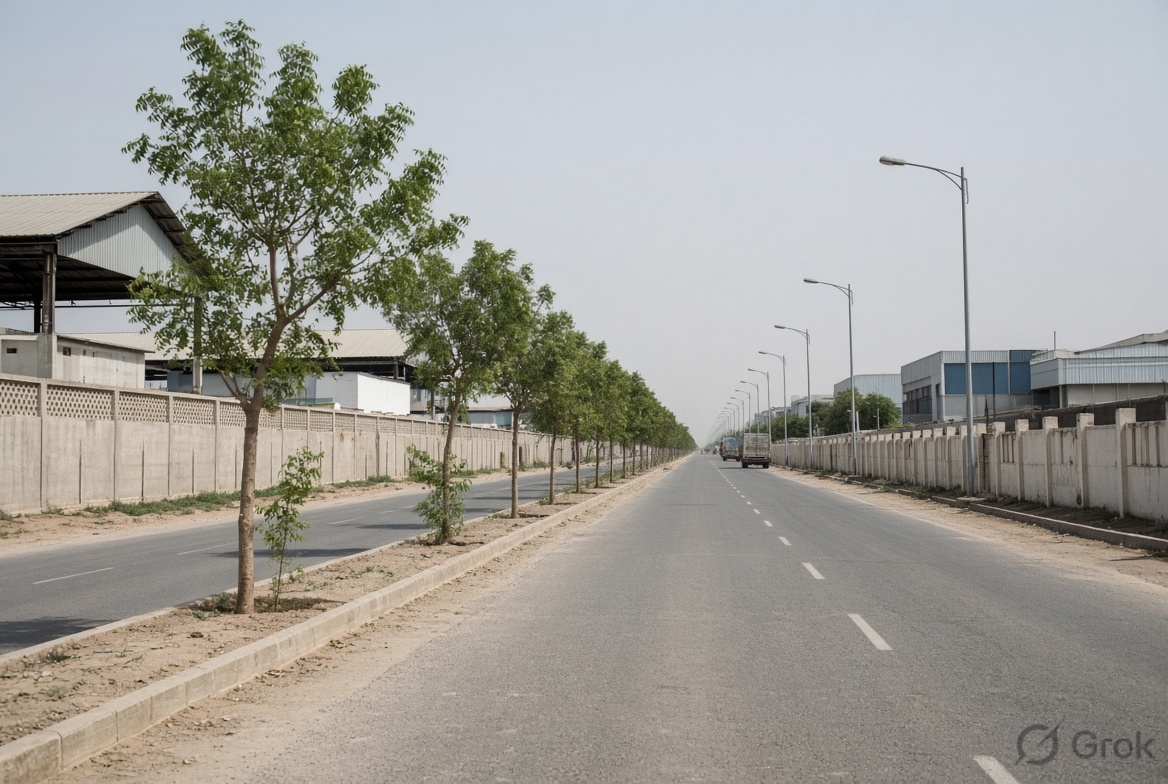
Neemrana sits inside that machinery rather than beside it. The town already has operating factories, RIICO land sales nearby, and a planning frame in the Shahjahanpur-Neemrana-Behror 2041 map. It also has the usual last-mile file. Power reliability, industrial roads, water and municipal services decide whether a grounded project here is a working unit or a foundation stone. A state that measures groundbreaking will either fix those pipes or expose them.
The economic logic is simple. Capital that has already signed will look for jurisdictions that can allot, connect and permit on a clock. A corridor with live plants is better placed to absorb that capital than a greenfield slide, provided the same clock applies to Neemrana’s utilities as to a Jaipur announcement. Groundbreaking is not output. Output is a shift that runs. Rajasthan’s next development story is whether the two are allowed to mean different things.

Heat is back on the Alwar forecast. It is a factory cost, not only a weather line.
Effluent-treatment headroom checked as units grow.
Read the full story
Heat is back on the Alwar forecast. It is a factory cost, not only a weather line.
Effluent-treatment headroom checked as units grow.
Read the full storyLocal reporting on 22 September said Alwar’s maximum could climb toward 39°C by 25 and 26 September after a monsoon season running a little below normal rainfall. Other public forecasts for the same week sit in the low-to-mid 30s. Either way the industrial point is unchanged. Late-September sun on shed roofs, bus stops and worker yards is an operating expense. It hits HVAC loads, water demand, night-shift recovery and the willingness of staff to stay.
Neemrana does not need a new climate slogan to act on that. It needs a short works list. Shade along industrial streets and at factory gates. Cool-roof coatings and insulation on existing sheds. Efficient chillers and motors where paint, electronics or assembly already run. Solar canopies over parking that cut both glare and a slice of the power bill. Landscaping that uses treated water, not tanker-fed lawns. Rest rooms, drinking water and shift design that assume a 39-degree afternoon. Housing that does not trap heat after the night shift.
None of that makes the town a cool corridor by announcement. It makes a plant cheaper to run and easier to staff when the forecast repeats in May. Japanese and Indian units already buy air-conditioning and complain when power trips. Heat-resilient kit is the same procurement problem as energy efficiency. Specify it in plot rules and in factory expansions. Score streets and canteens the way a buyer scores yield.
A heat-resilient framework is therefore a building code and a purchase order, not a vision map. The temperature this week is the reminder. The bill arrives every summer.

The Centre Eyes Film Awards at Tourist Sites: Neemrana could be a Strong Contender
Corridor freight via the DFC terminal.
Read the full story
The Centre Eyes Film Awards at Tourist Sites: Neemrana could be a Strong Contender
Corridor freight via the DFC terminal.
Read the full storyOn 22 September, while the 72nd National Film Awards were being held at Ekta Nagar in Gujarat, Information and Broadcasting Minister Ashwini Vaishnaw asked states to nominate their strongest tourism destinations for future editions. Proposals, he said, must show facilities and a 360-degree development plan. The selected state would host a later ceremony at that site. Rajasthan should put Neemrana forward.
The visual ingredients on this stretch are real and smaller than a national awards night. Neemrana Fort-Palace is a heritage object on the Delhi-Jaipur highway. Industrial sheds and the Japanese Zone give a second frame. Fort plus factory is already the sort of contrast brand and corporate units sometimes want for a two-day shoot. That work needs permissions, rooms, power, a kitchen and a road that a generator truck can use. It does not need a red carpet.
A film and heritage prospectus can list those assets without claiming the awards. Fort interiors and courtyards. Highway access from NCR. Factory-visit backdrops if a plant agrees. Jaipur’s crew and hotel depth an hour-class drive away. What the town still lacks for a national ceremony is the same list the minister asked states to attach. Large halls, guest rooms at ceremony scale, broadcast-ready power and a published 360-degree plan.
The near-term market is commercials, corporate films and small brand events that already travel this highway. The awards invitation is a reminder that destinations are now judged on facilities, not only on a monument photograph. If Rajasthan ever files a bid, Neemrana would have to show that plan in writing. Until then the heritage-screen economy here is a fort that can be hired and a factory skyline that can be framed. It is not a nominated awards venue.

Briston is pitching a Japanese-style address next to Neemrana’s factories
Real water/mobility item, separate from the pitch.
Read the full story
Briston is pitching a Japanese-style address next to Neemrana’s factories
Real water/mobility item, separate from the pitch.
Read the full storyBriston has put a township on the public map in the language Japanese assignees already know on briston.co.in on the map under Japanese floor-plan language. The site shows 1LDK and 3LDK layouts, a master-township walkthrough and amenity claims for security, water, power backup and fire systems. It places the project in Neemrana and sells it as a live-work-shop destination on the NCR side of Rajasthan.
The industrial reason for that pitch is genuine. Neemrana already hosts a Japanese manufacturing cluster on the Delhi-Jaipur highway corridor (NH-48). Plants need nearby rooms for managers, engineers and visiting staff. A residence that uses LDK planning, 360-degree previews and a mixed retail floor is aimed at that demand. Highway access is the practical advantage of this stretch.
Neemrana Signal has already checked the RERA approval on the RERA site which is genuine and there is a sanctioned plan.
Briston is one of the few public sites that speaks to Japanese-format apartments in Neemrana rather than only to generic highway flats. The Japanese factories remain the town’s proven identity. The project is a residential concept attached to that identity. Readers who want statutory comfort should match the brochure to a RERA ID, a sanctioned layout and a location plan on NH-48.
The project is being built for Japanese residents and is being pitched as an future investment proposal for Indian investors who are interested in long term lease of 10-20 years to Japanese companies through the project developers. The facility is projected to be managed by leading five star managed residences company.