
The precision work is already here. The chip money is still a commitment.
Third plant (~JPY 10bn) tracks to Sep 2026 completion.
Read the full story
The precision work is already here. The chip money is still a commitment.
Third plant (~JPY 10bn) tracks to Sep 2026 completion.
Read the full storyNeemrana does not need a wafer fab to feel Semicon 2.0. It needs to know which of its existing plants can hold a tolerance. On 17 September 2026 the Ministry of Electronics and Information Technology said Semicon 2.0 had already drawn investment commitments of about ₹1 lakh crore, roughly 11 to 12 billion dollars. Close to one lakh jobs were described as expected across the wider ecosystem. The money is to land over two to three years, and only after boards and shareholders sign. MeitY listed six pillars. Design. Machines and materials. Fabs. Advanced packaging. Research. Talent. The minister’s own press line put gases, chemicals, equipment, ATMP and substrates inside that bag. Those are commitments. They are not plants on the Delhi-Jaipur highway.
Rajasthan’s Semiconductor Policy 2026 already pointed at this belt for a different reason. In the official PDF the state listed Neemrana-Ghiloth among four corridors it calls semiconductor-adjacent. It named Japanese anchors Daikin, Nidec and Tokai Rika Minda, plus white-goods scale at Lloyd, as demand for power, control and sensing chips and as a culture of lean and QMS that packaging and final test would need. That is a policy claim about pull and discipline. It is not a notification that an ATMP line has been allotted here.
What is operational is older and narrower. Nidec’s third building at Majrakath was planned to make steering motors, park-lock actuators and electric pumps, with a company target of September 2026. Motors, housings, fixtures and incoming inspection already sit in this cluster. Clean packaging for a chip tray is a higher grade of the same habit. So are calibrated jigs, traceable lots, dry-room storage, high-purity gases and a truck that does not bake a reel on NH-48 in May. Those are the rows a capability map should score. Not “semiconductor city.”
The gap is still a list with empty cells. Who in Neemrana or Ghiloth can run ISO 14644-class rooms, or even a well-kept ISO 7 corner. Who can machine a fixture that does not shed. Who can certify industrial gas purity. Who can show a serial-number trail from inbound coil to outbound carton. Who can keep a night shipment cold and timed. Water and 132 kV reliability, already argued in this corridor, matter more to yield-sensitive work than a brochure about chips.
Do not write that Semicon 2.0 has arrived as a factory. Write that the state’s own policy treats this belt as a supplier and tester catchment, and that no public roster yet proves which MSME can meet that grade.
Watch named ATMP or materials filings that actually cite Alwar or Kotputli-Behror. Watch whether Nidec’s third building is running, not only cleared. Watch an ITI spoke syllabus that names cleanroom and metrology, not generic fitter trade. Until those files exist, Neemrana’s precision economy is a map of plants that already hold a micron. It is not a second Dholera.

The first climate customer here is a factory gate, not a desert park
Supplementary DPR and funding under Rajasthan review.
Read the full story
The first climate customer here is a factory gate, not a desert park
Supplementary DPR and funding under Rajasthan review.
Read the full storyRajasthan’s new storage news is real. It is not a Neemrana asset. On 15 and 16 September 2026 ACME Solar said a subsidiary had commissioned Phase I battery storage of 53.63 MW and 300 MWh at Kelan in Bikaner, part of a much larger firm-and-dispatchable project. A later company note added a second BESS slice at the same site. That is grid storage in the west of the state. It proves Rajasthan can host batteries at commercial scale. It does not put a container behind a Japanese Zone shed.
What Neemrana already has is older and smaller. NICDC’s 6 MW model solar plant, an Indo-Japan corridor project, was reviewed again in May 2026 when the DPIIT secretary visited. Officials described 6 MW of photovoltaic capacity and a SCADA system on a 5 MW block meant to show industrial micro-grid use. That is a demonstration and a grid feed. It is not proof that every RIICO plot now runs on sun. On 29 July 2026 a local report said Kaushal Green Energy commissioned 2.4 MW at Mohladia and tied it to the Neemrana GSS. Treat that as reported commissioning, not a corridor-wide power plan.
The buy list for a live plant is plainer than a green-hydrogen slide. Meters that show which line eats power on a night shift. Efficient motors and VFDs on compressors that already exist. Smart cooling on paint and electronics halls. Rooftop solar where roof load and DISCOM rules allow. A small battery that rides through a trip, not a 300 MWh park. Waste-heat recovery on ovens. Closed-loop water where process heat and effluent already run. Nidec’s May 2026 environmental clearance for the Majrakath expansion still listed diesel gensets rising with load, and a renewable share written as a percentage of demand. That mix is the honest factory picture. Backup oil plus some solar, not a net-zero campus.
June’s tripping meetings in the RIICO hall are the demand signal. A plant that loses a shift will pay for monitoring and ride-through before it pays for a brand of climate virtue. The commercial map is therefore a shop-floor scorecard. Who has a working EMS. Who has rooftop with a working net meter. Who reuses process water. Who still dumps heat and tanker-hauls.
Neemrana has not become Rajasthan’s first climate-tech market but the state’s storage build is underway in Bikaner, that a corridor solar demo already is here, and that the next rupee of industrial energy kit will be sold against outage minutes and water bills. Watch DISCOM interconnection queues for rooftop. Watch whether any factory tenders a measured kWh cut rather than a CSR panel. Watch if the 132 kV work and a factory battery are ever planned as one system. Until then the customer is the line supervisor who cannot afford another trip.

Scrap is already leaving the gate. A circular economy would keep the value inside the belt
The live deadline, explained.
Read the full story
Scrap is already leaving the gate. A circular economy would keep the value inside the belt
The live deadline, explained.
Read the full storyGlobal buyers now ask what happens after the carton, the coolant and the rinse water. That pressure is real. It is not proof that Neemrana has a recovery industry. What this corridor generates is predictable. Packaging from inbound parts and outbound motors. Metal and plastic offcuts from machining. Construction debris when a third shed goes up. Spent grain and effluent if a brewery runs as the company says it does. E-waste from controls and rejected boards. Canteen waste from two-shift kitchens. Hazardous streams that already sit in red-category rules. None of those flows is published as a tonnage sheet for Alwar or Kotputli-Behror. Without weights and destinations, circular talk is a slogan on a CSR tank.
The enterprise list is therefore a set of missing firms, not a cluster. A packer who can take clean carton and film back into a graded wrap. A scrap yard that issues a traceable weighbridge ticket a Japanese QMS will accept. An ETP chemical and sludge handler with a live consent. A construction crusher that does not dump on the Aravalli edge. An authorised e-waste collector who actually picks up from MSMEs. A spent-grain or canteen-oil user with a food-safety paper. Each of those is a founder category only if a plant will sign a offtake and a board will issue a consent.
Water is the tightest loop. Industry has asked for Yamuna and a reservoir on paper. A plant that reuses process water buys itself hours in May whether or not the feeder is built. Heat recovery and efficient motors belong in the same ledger as scrap. They cut a bill. They do not by themselves make a circular park.

A return needs a job that holds and a Tuesday that works. A corridor brand is not enough
Effluent-treatment headroom checked as units grow.
Read the full story
A return needs a job that holds and a Tuesday that works. A corridor brand is not enough
Effluent-treatment headroom checked as units grow.
Read the full storyRajasthan already sends engineers to Bengaluru, Gurugram, Tokyo shop floors and Korean lines. The question in this brief is whether some of them come back to the SNB belt with a reason that survives the first summer.
What exists is a manufacturing roster, not a talent campus. Japanese plants, Indian-zone units, a company-reported brewery start, and a state policy that treats Neemrana-Ghiloth as semiconductor-adjacent demand. A PM-SETU cluster now names Neemrana ITI as a spoke under Bhiwadi. That is a training pipe. It is not a lab offer letter. Semicon 2.0’s national job talk is a commitment over two to three years, subject to boards. It has not posted roles on this highway.
What a returning professional actually checks is dull. Can a spouse find a school. Can a clinic take a call after 10. Is the lease payable by a foreign or startup entity. Does fibre hold a design review with Osaka. Does the plant still trip. Is there a founder path that sells gauges and software to factories rather than another relocation to a coastal electronics park. Japan and Korea matter here as employers already on the ground, not as lifestyle flags. Housing schemes that claim those flags remain unverified until papers exist.
The honest pull is specific work. A metrology lead who has run incoming inspection in Aichi. A maintenance coder who has tagged motors. A food-safety operator who can feed a posted crew. A researcher only if a plant or a lab signs a data protocol. A founder only if a purchase order follows the pitch.

The next company here may never pour a casting. It may keep the casting line running
Corridor freight via the DFC terminal.
Read the full story
The next company here may never pour a casting. It may keep the casting line running
Corridor freight via the DFC terminal.
Read the full storyNeemrana’s known economy is plants. Japanese Zone units, Indian-zone sheds, a brewery that the company says started in July 2026, motors and heat and night shifts. Around that load sits a quieter market. Someone has to test incoming parts. Someone has to move a reel without cooking it on the highway. Someone has to reset a VFD at 2 a.m. Someone has to invoice a Tokyo accounts team. Someone has to feed a crew that will not eat oil twice.
Those are founder categories, not a campus. Calibration and fixture shops that can hold a drawing from a Japanese QMS lead. Packaging and dry-store for anything that later wants a semiconductor-adjacent grade. Cold or timed freight, not another general transporter. Energy meters and rooftop paperwork after the June tripping meetings. Water reuse and ETP chemicals where a red-category process exists. Bilingual HR and payroll for posted staff. Food and laundry that survive a week-long installer stay. Safety trainers who can walk a shop instead of selling a poster. Book-keepers who understand GST without inventing invoices.
The gap is that none of this is a public roster. MSME workshops on GI tags and export schemes have been held. They do not list who can already pass a gauge audit. An Industrial Founder Programme would start with purchase orders, not pitch decks. Which plant will trial a local calibration lab for 90 days. Which hotel will subcontract long-stay meals. Which ITI spoke will place two trainees on predictive-maintenance tagging.

Three flags on one highway is not a strategy. A shared shop floor would be.
51 companies (Embassy/JETRO, Oct 2024) — a voluntary survey.
Read the full story
Three flags on one highway is not a strategy. A shared shop floor would be.
51 companies (Embassy/JETRO, Oct 2024) — a voluntary survey.
Read the full storyNeemrana already has a Japanese manufacturing identity. That part is not an opinion. RIICO and JETRO reserved a country-specific pocket after 2006. Official counts in 2024–26 sit in the high forties to the mid-fifties. Motors, air-conditioning, auto parts and quality systems grew up there. Rajasthan’s own semiconductor-adjacent note still points at Daikin, Nidec and Tokai Rika Minda as anchors that pull sensing chips and enforce lean habits. That is a discipline already paid for in rejected lots and night-shift audits.
Korea is the missing middle of this brief. India buys Korean phones, steel process know-how and consumer-electronics speed. Neemrana does not yet publish a Korean Zone with a JETRO-style roster. White-goods scale in the wider Alwar belt, including names the state policy groups with Japanese plants, is adjacent demand. It is not proof that a Seoul design studio sits next to a Majrakath line. Any triangle story that treats Korean speed as a local fact is advertising. Treat it as a partnership still to be booked.
India’s piece is already on the payroll. Tool-room hands, diploma engineers, and a new PM-SETU spoke that names Neemrana ITI under a Bhiwadi hub. Scale here means second and third sheds, Ghiloth overflow plots, and vendors who can cut a fixture twice. It does not yet mean a certified clean-pack or a bilingual night clinic that a visiting Korean or Japanese family will use without a Gurugram run.
Rajasthan’s cost line is land and wages relative to coastal electronics belts. It is also outage minutes, tanker water and a 132 kV house that industry still calls proposed in the Japanese Zone. Cost that fails a yield audit is not an advantage.
The practical meeting point is therefore small. A shared metrology room. A vendor day where a Japanese QMS lead, a Korean product manager and an Indian fixture shop compare one drawing. A corporate-lease block that invoices in a form Tokyo and Seoul accounts will pay. An ITI module that teaches incoming inspection to the same standard the Japanese Zone already rejects parts against. A forum can host that. A slogan cannot.
Neemrana is one culture that is operational, the second is a national supply relationship without a local register, and the third is talent that still lacks the rooms and power the first two would demand.
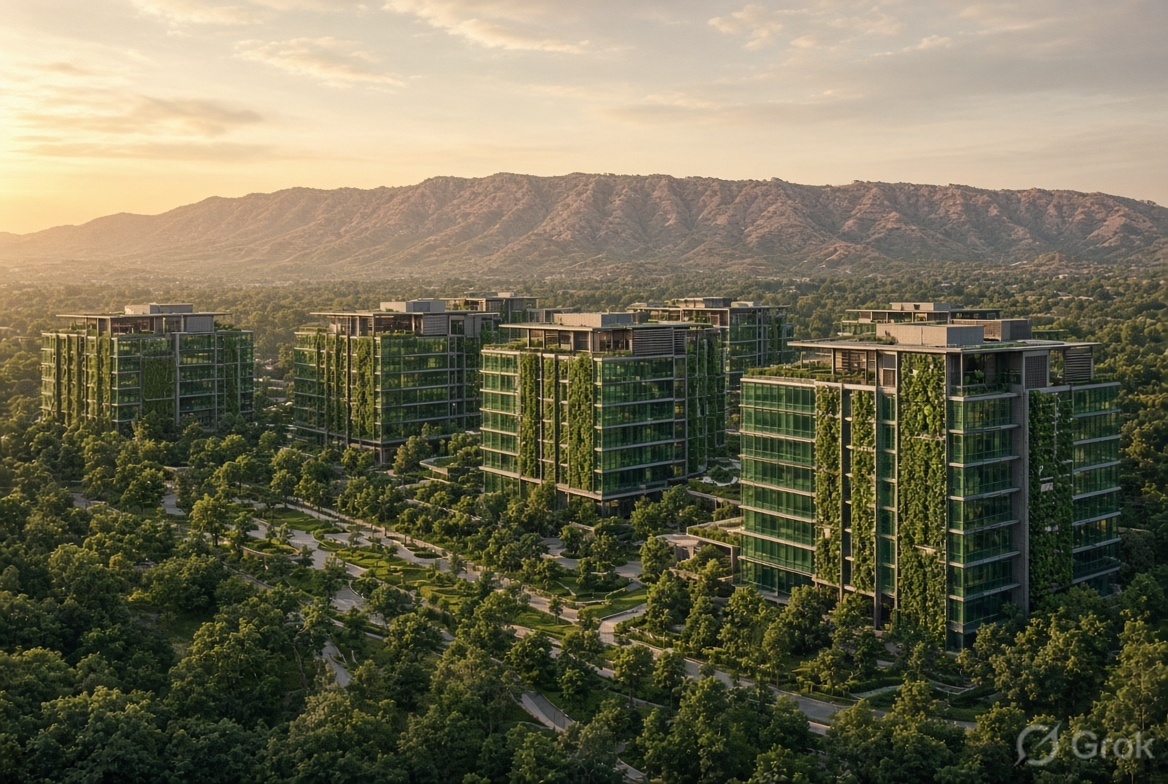 Proposed concept
A living lab needs one willing line. It does not need three thousand acres.
A proponent's vision — read against what the corridor actually has.
Read the full story
Proposed conceptA living lab needs one willing line. It does not need three thousand acres.
A proponent's vision — read against what the corridor actually has.
Read the full storyArtist impression · Proposed concept · Not allotted land
The Emerald Valley is a development vision of its founder. This desk treats it as a project thesis. It is not a sale of plots. It is not a notified industrial area. Project materials have spoken of a large sustainable technology district and a wide first phase. Those acreage figures remain project-supplied. They are not title, allotment or environmental clearance.
What is real next door is older. Japanese and Indian plants already run motors, heat, paint and night shifts. Predictive maintenance, energy meters, digital twins and vision inspection are products those plants can buy if the kit survives dust, voltage dips and a May afternoon. An AI district that cannot plug into that load is a software conference with better landscaping.
The useful design is therefore a small living laboratory. The honesty test is the same as the Phase One water test. Who controls the land. Who pays the power bill. Which plant signs the data-use letter. Which model is barred from export of process secrets. Until those four answers exist the status does not move. Private concept. Adjacent to an operational cluster. Not an approved AI park.

A lifestyle list is not a building. Bristone is a Lease for next 90 years for proud owners.
Real water/mobility item, separate from the pitch.
Read the full story
A lifestyle list is not a building. Bristone is a Lease for next 90 years for proud owners.
Real water/mobility item, separate from the pitch.
Read the full storyBristone is described as creating a ripple by carving Japanese and Korean residences right on NH 48 its site certified by Neemrana Signal.
Bristone will have lounges, concierge, fibre, wellness, dining clubs, Japanese sports, karaoke, golf and weekend travel. Those are products a posted engineer might buy.
What a Japanese or Korean professional actually needs on this highway is shorter. Water that holds pressure in May. Power that survives a trip. Internet that does not drop a call to Nagoya. Food that does not require a weekly Gurugram run. A clinic after 10. A cab that knows the factory gate. A lease an accounts team can pay without a personal PAN drama. Schools and language help if a family stays. Existing highway hotels and a few serviced rooms can be marked against that list today. Bristone has all that.
Community dining and cultural clubs and a kitchen that passes a foreign buyer’s hygiene test.
Bristone defines global professional living in Neemrana. The corridor still lacks a public register of long-stay rooms that clear a simple service stack.