A New Daikin Facility Points Towards Neemrana's Next Industrial Geography
Third plant (~JPY 10bn) tracks to Sep 2026 completion.
Read the full story
A New Daikin Facility Points Towards Neemrana's Next Industrial Geography
Third plant (~JPY 10bn) tracks to Sep 2026 completion.
Read the full storyMajarakath is emerging as an important address in Neemrana’s next layer of industrial development.
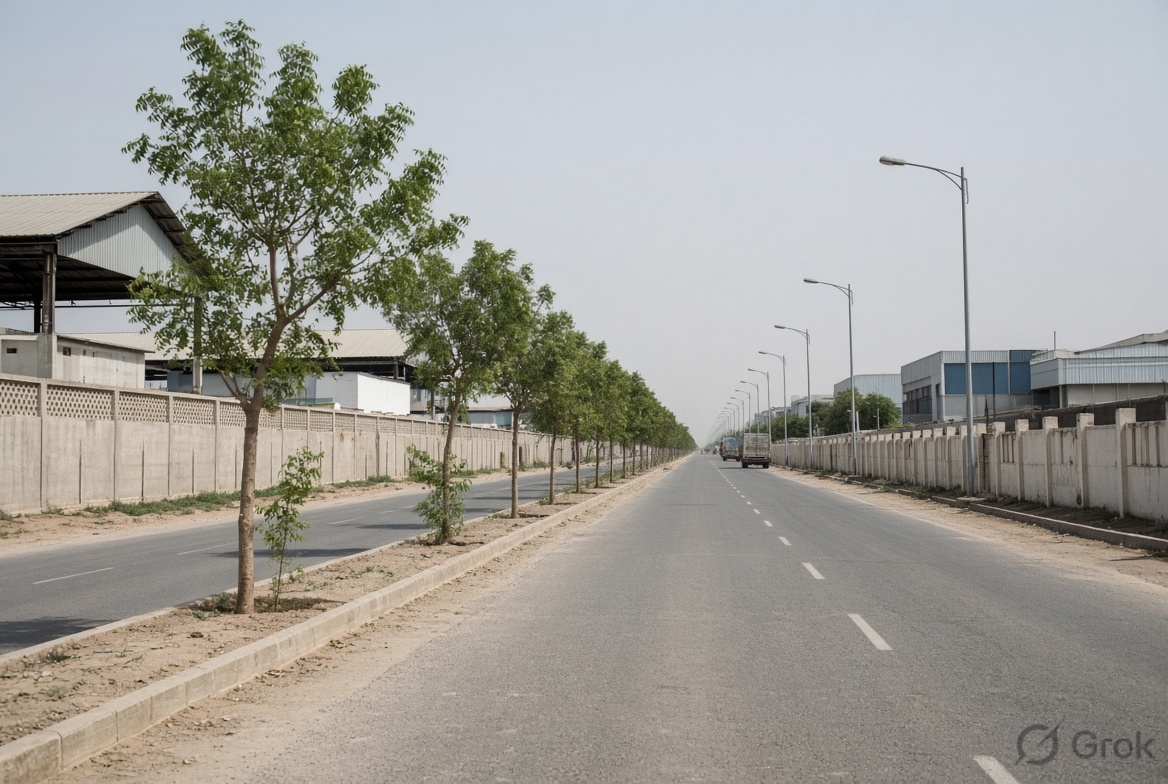
A recent industry project listing has identified a proposed Daikin Airconditioning India industrial facility in RIICO’s Majarakath Industrial Complex. Daikin’s own Indian and global location information already identifies plots SP2-12 to SP2-15 and SP2-24 to SP2-27 at the RIICO New Industrial Complex, Majarakath, as its Neemrana factory manufacturing base. The exact scope, timing and configuration of the reported new facility need further official detail. Yet the signal is clear. Majarakath is increasingly relevant to the geography of advanced manufacturing around Neemrana.
That matters because industrial corridors grow not merely through the gates of individual factories. A new or expanding industrial site changes the economics of the land around it. It creates the next opportunity for material suppliers, component makers, maintenance specialists, transport operators, canteen providers, security firms, staffing agencies, packaging businesses and digital service providers.
For RIICO plot holders, Majarakath’s appeal lies in this wider economic effect. Manufacturing anchors tend to draw a network of supporting activity. Smaller firms can find roles in fabrication, electrical work, industrial consumables, warehousing, equipment servicing and last-mile movement. Local entrepreneurs can build services around daily factory life, from food and worker transport to technical training and managed accommodation.
The corridor’s most valuable development question is therefore not simply where a manufacturer locates its next facility. It is whether surrounding infrastructure can keep pace. Reliable internal roads, utility readiness, water management, power resilience, organised freight movement and safe worker mobility will help translate industrial presence into a more complete urban economy.
Majarakath also points to an evolving pattern within the Neemrana and SNB region. As established industrial names continue to use the corridor, attention can move beyond the original factory footprint towards the service economy that sustains production. That includes rented homes for workers and supervisors, serviced residences for visiting engineers, small business hotels, food outlets and professionally managed transport links.
The opportunity for developers is to create useful, well-run industrial support infrastructure that serves a globally connected manufacturing base. For local youth and MSMEs, it is a platform for skills, contracts and enterprise participation.
The Industrial Corridor Needs Hospitality Talent More Than Rooms
Supplementary DPR and funding under Rajasthan review.
Read the full story
The Industrial Corridor Needs Hospitality Talent More Than Rooms
Supplementary DPR and funding under Rajasthan review.
Read the full storyNeemrana’s industrial economy has created a powerful case for a parallel hospitality skills economy. The Union Budget 2026-27 has proposed upgrading the National Council for Hotel Management and Catering Technology into a National Institute of Hospitality, designed to strengthen the connection between academia, industry and government. It also proposes a pilot programme to upskill 10,000 tourist guides across 20 iconic destinations through a structured 12-week hybrid course developed with an Indian Institute of Management. Together, these measures recognise hospitality as a professional capability with direct value for jobs, visitor confidence and local enterprise.
For Neemrana and the SNB corridor, this national direction has a highly practical local application. Industrial visitors do not arrive only for leisure. They come for factory commissioning, supplier meetings, audits, training, recruitment, equipment installation, trade engagement and corporate events. Japanese and Korean managers, engineers and business travellers may require reliable stays, culturally aware service, efficient local transport, food options and clear communication.
That demand cannot be met by rooms alone. It requires people trained to run front desks, manage corporate reservations, maintain guest facilities, deliver food safely, coordinate business events and respond confidently to international visitors. It also creates scope for a new generation of local guides and hosts who can connect industrial guests with Neemrana Fort, the wider Alwar region, local food traditions and Rajasthan’s heritage economy.
A Neemrana hospitality training platform could therefore serve several markets at once. Hotels and guest houses could access better prepared staff. Homestays could learn service standards, digital booking practices, guest safety and housekeeping systems. Young people could develop careers in culinary work, hotel operations, travel support, events and facility management. Local entrepreneurs could establish transport desks, laundry services, catering businesses, language support and corporate welcome services.
The wider economic effect would be significant. As manufacturing becomes more globally connected, hospitality becomes part of industrial infrastructure. A well-managed executive stay can support a supplier relationship. A capable events team can help a company host training or dealer meetings. A professionally run homestay can widen the corridor’s accommodation base while bringing more residents into the service economy.
Neemrana has an opportunity to develop training around its own distinctive mix of industrial travel, heritage tourism, weddings, corporate meetings and long-stay international residents. The curriculum need not wait for a large institutional campus. It could begin through partnerships among hotels, training institutes, local businesses, industry associations and digital learning providers.
Neemrana Can Become A Service Base For Rajasthan Clean Energy Economy
The live deadline, explained.
Read the full story
Neemrana Can Become A Service Base For Rajasthan Clean Energy Economy
The live deadline, explained.
Read the full storyThe next solar opportunity for Neemrana may lie well beyond the rooftop. At the BRICS Industry Ministers’ Meeting in Jaipur, member countries adopted terms of reference and an action plan for a Photovoltaic Industry Working Group. The framework places solar manufacturing, technology exchange, capacity building and stronger supply-chain cooperation firmly on the industrial agenda. The subsequent BRICS declaration also supported a Solar Photovoltaic Cooperation Roadmap focused on technology, finance and skills. [
For Neemrana and the SNB corridor, the important signal is that clean energy is becoming a wider manufacturing and services economy. Solar panels are the most visible part of that economy, but they are only one component of a much larger value chain. Mounting structures, cables, inverters, electrical panels, monitoring systems, testing services, battery maintenance, industrial controls, software and skilled technicians all have roles to play.
This gives Neemrana a future opportunity to develop as a service base for Rajasthan’s clean-energy build-out. Its established manufacturing ecosystem and location within the Delhi Jaipur industrial corridor could support firms that make or supply industrial components, maintain energy systems and develop digital tools for factories seeking better control over power costs, consumption and resilience.
The proposition for Japanese and Korean companies could be especially relevant. Both economies have deep capabilities in power electronics, energy management, automation, batteries and advanced manufacturing. Neemrana’s existing international industrial character provides a useful platform for supplier partnerships, technical support operations, training programmes and locally adapted industrial energy solutions.
The opportunity for MSMEs is equally significant. Fabricators could explore solar mounting and enclosure systems. Electrical contractors could build expertise in installation and industrial maintenance. Software founders could create energy dashboards, asset-monitoring tools and predictive-maintenance systems. Training providers could prepare technicians for solar operations, battery services, electrical safety and energy-efficiency audits.
A stronger clean-energy ecosystem would also widen the regional development dividend. It can create skilled jobs, support local service businesses and help industrial sites pursue more reliable and resource-efficient operations. Water-conscious site planning, energy monitoring, renewable generation, storage and circular-economy practices can strengthen Neemrana’s credentials as a sustainable growth proposition rather than simply another factory location.
This is not a claim that a particular clean-energy park or supplier cluster has been approved for Neemrana. It is an emerging investment proposition grounded in the corridor’s industrial logic and the direction of international photovoltaic cooperation.
Neemrana Can Connect Rajasthan Farms to India's Industrial Food Economy
Effluent-treatment headroom checked as units grow.
Read the full story
Neemrana Can Connect Rajasthan Farms to India's Industrial Food Economy
Effluent-treatment headroom checked as units grow.
Read the full storyRajasthan’s next food economy will be built not only in fields and mandis, but in the networks that connect crops to processing, packaging, storage and markets.
The state is mapping proposed agro-processing clusters with crop-wise and region-wise production details to identify export, investment and market-access potential. Work is reported to be advancing around ten crop-led clusters covering moong, mustard, soybean, kinnow, pomegranate, guava, orange, isabgol, cumin and garlic. The purpose is practical. Better links between production areas, processors and markets can reduce post-harvest loss and give farmers stronger market access.
Neemrana and the SNB corridor open a future opportunity to serve Rajasthan’s food economy as a processing, packaging, cold-chain and logistics base. The Delhi Jaipur industrial corridor brings food businesses closer to large consumption markets in Delhi NCR while connecting them to Rajasthan’s agricultural hinterland. A well-organised Neemrana proposition could help move products from farm clusters into higher-value food supply chains.
The logic extends beyond large food factories. A modern food system requires packhouses, sorting facilities, quality testing, temperature-controlled storage, transport coordination, warehouse management, packaging material, labelling, traceability and digital inventory tools. Each element can support a more diverse local enterprise economy.
Alwar already has recognised potential in food processing. Rajasthan’s official food-processing profile identifies onion-based products as Alwar’s One District One Product category, while state investment material identifies Alwar as a processing location for wheat, oil, milk and prepared foods. That provides a useful regional base from which Neemrana can explore complementary food-services and logistics capabilities.
Farmers and farmer producer organisations pivot better aggregation and cold-chain systems can create clearer routes from production to buyers. MSMEs' opportunity includes spice cleaning, grain processing, food-grade packaging, refrigerated distribution, equipment repair, quality certification support and digital market services. For warehouse operators, food-grade handling and temperature-controlled capacity may become an important next layer of industrial development.
The sustainable-development case is equally strong. Efficient cold chains, modern storage, better forecasting and local processing can help reduce avoidable waste while creating more value closer to the source of production. Food businesses can also invest in water efficiency, solar-assisted operations, reusable packaging systems and organic-waste management.
Neemrana does not need to become every part of Rajasthan’s food economy. Its opportunity is to become a reliable industrial gateway where farm products can be processed, protected, packaged and dispatched with greater consistency.
Neemrana's Next Japanese Opportunity Is Supplier Depth
Corridor freight via the DFC terminal.
Read the full story
Neemrana's Next Japanese Opportunity Is Supplier Depth
Corridor freight via the DFC terminal.
Read the full storyThe completion of industrial plot allotment in Neemrana’s Japanese dedicated area marks a useful transition for the corridor. The next question is not simply where Japanese manufacturers will locate. It is how deeply the surrounding industrial ecosystem can serve them.
JETRO reported in September 2025 that RIICO had notified relevant departments that allotment of industrial plots in Neemrana’s Japanese-company dedicated area, which began in 2007, had concluded. Rajasthan had secured and developed 596 acres for the zone, while JETRO supported incoming Japanese companies under its partnership with RIICO.
That achievement creates a stronger platform for growth. Industrial land is the first layer of a manufacturing ecosystem. The next layer is supplier depth.
Japanese factories require far more than a plot, a building and a production line. They need dependable local partners for machining, fabrication, moulding, tooling, industrial consumables, maintenance, calibration, logistics, safety equipment, packaging, quality documentation and workforce services. They also require access to testing capacity, process expertise, reliable utilities and vendors able to work to consistent standards.
This is an important conversation for Indian MSMEs in the Neemrana corridor. The most valuable vendor relationship is often built gradually. It begins with maintenance contracts, spare parts, basic components, facility services or logistics support. With the right quality systems, technical capability and delivery discipline, local enterprises can progress towards higher-value supply roles.
A Japanese Supplier Readiness Programme could help make that transition more organised. It could identify the requirements of manufacturers, map capable local and regional vendors, explain quality expectations and create practical pathways in certification, process improvement, export documentation, workplace safety and digital procurement. Such a programme would not guarantee contracts. It would give vendors a clearer route towards becoming credible industrial partners.
The wider economic effect reaches beyond the factory gate. A maturing Japanese industrial ecosystem creates demand for employee transport, professional housing, serviced stays, food services, healthcare support, language assistance, training facilities and local business services. These are not peripheral activities. They help international manufacturing teams operate efficiently and make the corridor more attractive to future companies.
This opens a substantial advisory market around vendor development, lean operations, environmental systems, quality assurance and workforce planning. For local entrepreneurs, it creates space to build specialised businesses that can grow alongside production activity.
Neemrana’s Japanese zone has already established a powerful industrial identity. The future opportunity is to convert that identity into a denser network of capable suppliers, service firms and skilled workers.
A Technology District Needs A Place Where Ideas Can Meet
51 companies (Embassy/JETRO, Oct 2024) — a voluntary survey.
Read the full story
A Technology District Needs A Place Where Ideas Can Meet
51 companies (Embassy/JETRO, Oct 2024) — a voluntary survey.
Read the full storyA technology district is not defined only by offices, laboratories, residences or infrastructure. It also needs places where people can gather to exchange knowledge, test ideas and form commercial partnerships.
The Emerald Valley is a future conference, demonstration and learning centre could become an important part of the long-term regional vision. It would give the Neemrana corridor a dedicated setting for Japanese supplier meetings, industrial technology demonstrations, university programmes, startup events, clean-energy exhibitions and investor forums.
The commercial logic is straightforward. Manufacturing and technology ecosystems become stronger when companies can meet customers, suppliers, researchers, trainees and government stakeholders close to where they operate. A supplier showcase can help an Indian MSME demonstrate a component to an international manufacturer. An industrial software workshop can bring plant managers together with technology founders. A clean-energy exhibition can connect equipment companies, installers, finance specialists and factory teams.
For Neemrana and the SNB corridor, this would add a new layer to the existing industrial economy. The region already has a globally relevant manufacturing identity, particularly through Japanese and Korean business activity. A knowledge and convention facility could help convert industrial presence into a more active cycle of learning, collaboration and commercial discovery.
Universities and training institutes could use the venue for technical courses, skills demonstrations, placements and employer engagement. Technology companies could organise product launches and pilot showcases. Industrial groups could hold safety forums, quality workshops and supplier development sessions. Local entrepreneurs could participate through event production, catering, transport, interpretation, digital support, fabrication and visitor services.
The hospitality opportunity is equally important. Business events create demand for hotels, serviced residences, guest houses, restaurants, local transport and professionally managed visitor experiences. A conference calendar does more than fill rooms. It can build a more reliable business visitor economy, supporting operators throughout the year rather than only during individual corporate trips or wedding seasons.
A future Emerald Valley meeting space could also be designed around sustainable development. Energy-efficient buildings, renewable power, water-conscious landscaping, flexible exhibition infrastructure and green public areas would make the venue a demonstration of the values it promotes. It could show that industrial growth, innovation and environmental responsibility can advance together.
The proposition remains a development vision rather than an announced operational facility. Its value lies in identifying a practical future need. As Neemrana’s manufacturing, education and technology ambitions expand, the ability to convene people may become as important as the ability to accommodate them.
A Growing Industrial Town Needs An Urban Agenda To Match Its Ambition
An honest empty.
Read the full story
A Growing Industrial Town Needs An Urban Agenda To Match Its Ambition
An honest empty.
Read the full storyNeemrana’s recent municipal election offers a useful moment to focus on the practical work of building a modern industrial town.
The 2026 Rajasthan urban local body elections included Neemrana Nagar Palika, where voters elected representatives across 25 wards. The wider state election brought civic issues into renewed focus across 309 urban local bodies. For Neemrana, the most important outcome is the opportunity to place everyday urban services at the centre of the town’s next development phase.
Industrial growth is often measured through factory announcements, land allotments and investment interest. Yet companies, workers, residents and visitors experience a town through its streets, lighting, drainage, public safety, mobility and cleanliness. These are not secondary civic concerns. They are economic infrastructure.
A well-lit road supports safe movement for shift workers and women professionals. Reliable drainage protects homes, shops and industrial access routes during heavy rain. Clean public areas create a stronger first impression for visiting suppliers, executives and investors. Better markets and organised pedestrian spaces can help local enterprises benefit from the spending power generated by manufacturing.
Neemrana’s urban agenda can therefore be both practical and ambitious. It should consider worker mobility, dependable last-mile transport, safe walking routes, public toilets, waste collection, green spaces, digital grievance systems and visible civic maintenance. It should also recognise the needs of a town serving an increasingly international industrial ecosystem, including clear signage, accessible services, well-managed visitor areas and a culture of responsive local administration.
For companies, stronger urban systems can improve employee retention and make recruitment easier. Skilled workers and young professionals are more likely to build long-term lives in a place where daily services work well. For developers, a clearer public-services agenda can support better planning for housing, retail, healthcare, education and managed accommodation. For local businesses, a well-run town centre can expand opportunities in food, transport, maintenance, digital services and neighbourhood commerce.
The next opportunity is to treat civic pride as a development asset. Neemrana can become known not only for industrial activity, but for the quality and reliability of the urban environment around it. That would strengthen its position within the SNB corridor and help create a more complete urban economy.
A useful first step would be transparent, repeatable measurement. A public scorecard could track street lighting, drainage response, cleanliness, road condition, public-space upkeep, mobility, safety and citizen-service delivery ward by ward. Progress becomes more visible when residents, companies and local leaders can see what is improving and where attention is required.

Rajasthan Is Taking Its Investment Story Beyond Its Own Borders
Rooms/rates snapshot for visiting teams.
Read the full story
Rajasthan Is Taking Its Investment Story Beyond Its Own Borders
Rooms/rates snapshot for visiting teams.
Read the full storyRajasthan’s investment outreach is becoming a national network rather than a series of events held only within the state.
The recent Pravasi Rajasthani Meet in Bhubaneswar brought together more than 300 representatives of the Rajasthani community, business organisations and industry. Rajasthan’s delegation included senior officials from the Bureau of Investment Promotion, RIICO and the Industries and Commerce Department. Discussions covered investment, expansion and business cooperation in sectors including hotels and resorts, IT and logistics, food processing, metals and mining.
The earlier outreach agenda had also identified renewable energy, tourism, healthcare, textiles, metals and manufacturing as areas for engagement with Odisha-based business groups and the wider Rajasthani diaspora. This is a constructive model. Diaspora networks can bring not only capital, but sector knowledge, customer relationships, operating experience and long-term business partnerships.
The opportunity is to be presented as an industrial gateway within this wider Rajasthan story. A diaspora investor or family business exploring a Rajasthan connection may seek more than a general policy proposition. It may need access to Delhi NCR markets, national logistics routes, globally recognised manufacturing ecosystems and a practical operating environment for suppliers, services and future expansion.
Neemrana can offer a distinctive part of that proposition. Its position on the Delhi Jaipur industrial corridor, its association with Japanese manufacturing and its expanding regional service economy create a useful platform for industrial groups considering Rajasthan. The corridor can be relevant to manufacturers seeking supplier relationships, logistics firms building distribution capacity, technology companies serving factories and service operators supporting business visitors and industrial workforces.
The wider economic effect can be substantial. Diaspora-led enterprise often connects local capability with markets elsewhere in India and abroad. A family business with experience in metals, food, textiles, hospitality or renewable energy may find local partners, warehouse needs, technical talent and vendor opportunities in the Neemrana and SNB region. Such connections can help local MSMEs become part of larger value chains.
The task is to make investment information easier to understand for the region. Investors need clear explanations of industrial locations, relevant public infrastructure, vendor ecosystems, workforce availability, accommodation options and sector-specific opportunities. They also need careful distinctions between operational assets, approved programmes, planned infrastructure and future development propositions.
A Neemrana Diaspora Investment Briefing could provide that bridge. It could position the corridor not as a promise of automatic returns, but as a practical place for business research, partnership-building and long-term enterprise development.
The next opportunity lies in linking diaspora outreach with place-specific intelligence. As Rajasthan takes its story to Bhubaneswar and other business centres, Neemrana can make a credible case as a connected manufacturing base with room for suppliers, services, innovation and responsible growth.